
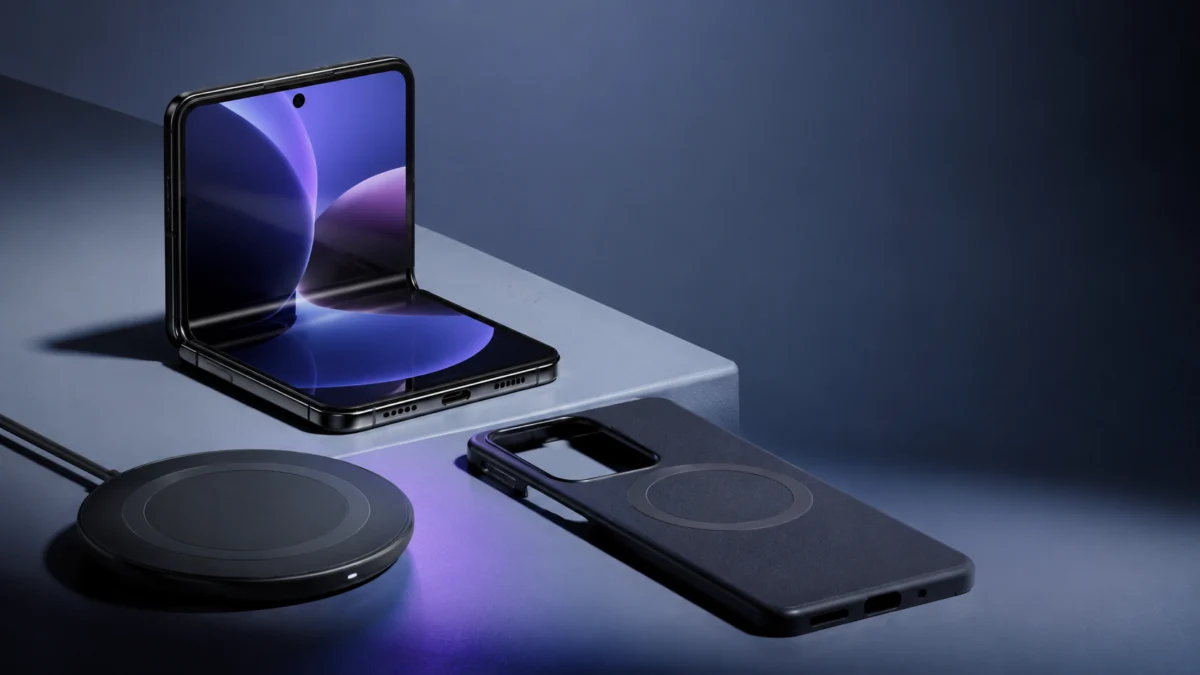
Only one mainstream foldable phone in 2026 has built-in magnets for native Qi2 charging: the Pixel 10 Pro Fold. Every other major foldable — including the Galaxy Z Fold 7, Galaxy Z Flip 7, Motorola Razr Plus 2024, and Oppo Find N5 — either requires a magnetic case to align with a Qi2 charger or does not support Qi2 at all. If you already own Qi2 accessories or plan to use a MagSafe-style power bank, car mount, or charging stand, this distinction will determine whether your setup works as expected before you spend four figures on a phone. Galaxy Z Fold 7 buyers who are considering a magnetic case for Qi2 charging should read the S Pen warning in this guide before purchasing anything. Magnetic cases cause confirmed dead zones on the inner display that disable the S Pen in those areas.
At a Glance: Foldable Qi2 Compatibility Comparison
The table below summarizes Qi2 status, built-in magnet availability, maximum wireless charging speed, and whether a case is required for Qi2. Model-specific details and caveats follow in the individual sections below.
| Phone | Qi2 Status | Built-In Magnets | Max Wireless Speed | Case Required for Qi2 | Key Caution |
|---|---|---|---|---|---|
| Pixel 10 Pro Fold | Native Qi2 (Pixelsnap) | Yes | 15W | No | Heat throttling confirmed; charging may pause mid-session |
| Galaxy Z Fold 7 | Qi2 Ready | No | 15W (with compatible magnetic case) | Yes | Standard magnetic cases cause S Pen EMR dead zones on inner display |
| Galaxy Z Flip 7 | Qi2 Ready | No | 10W (with compatible magnetic case) | Yes | Speed capped at 10W despite Qi2 Ready designation |
| Galaxy Z Flip 7 FE | Qi2 Ready | No | 10W (with compatible magnetic case) | Yes | Budget-tier clamshell; same wireless limits as Z Flip 7 |
| Motorola Razr Plus 2024 | No Qi2 | No (closure magnets only) | 15W standard Qi | N/A | Closure magnets attract mounts but are not load-bearing; car mount drops confirmed |
| Pixel 9 Pro Fold | No Qi2 | No | 7.5W | N/A | Charging coil near bottom edge; incompatible with most upright stands |
| OnePlus Open | No wireless charging | No | None | N/A | Wired only (67W SUPERVOOC) |
| Oppo Find N5 | No Qi2 | No | 50W AirVOOC wireless | N/A | Case needed for physical magnetic attachment; no Qi2 digital handshake |
Speed figures reflect manufacturer-stated maximums under optimal conditions. Real-world speeds vary by environment, case thickness, and thermal state. All Qi2 Ready designations require a compatible magnetic case to achieve Qi2 performance unless otherwise noted.
What Buyers Report: Issues to Check Before You Commit
Four recurring problems appear consistently across community reports from r/GalaxyFold, r/GooglePixel, and r/razr. These do not affect every user, but they appear frequently enough to factor into a purchase decision before committing to a model or accessory setup.
S Pen Dead Zones on Galaxy Z Fold Inner Displays With Magnetic Cases
According to multiple reports on r/GalaxyFold, users who installed MagSafe-compatible magnetic cases on the Galaxy Z Fold 6 experienced S Pen dead zones on the inner display — areas directly above magnet positions where the pen loses position detection, tilt detection, and hover function (r/GalaxyFold thread, second confirmed thread). Several users initially believed their display or S Pen was defective, and could consistently reproduce and eliminate the problem by installing and removing the magnetic case. Samsung calibrates for the Z Fold’s internal hinge magnets at the factory but cannot compensate for the variable field patterns of aftermarket cases. The Galaxy Z Fold 7, which Samsung requires to use a magnetic case to achieve Qi2 Ready performance, carries the same structural risk. If you rely on the S Pen for note-taking, drawing, or document work, confirm that any case you plan to use includes verified EMR shielding before relying on it for Qi2 alignment.
Pixel 10 Pro Fold Wireless Charging Heat and Mid-Session Pause
Multiple users on r/GooglePixel report that the Pixel 10 Pro Fold pauses wireless charging mid-session due to heat, with the charging pad surface reaching temperatures uncomfortable to touch (r/GooglePixel thread, second thread). The reported workaround involves unplugging and replugging the charger to resume. This does not affect every environment — ambient temperature and surface airflow influence how quickly thermal limits are reached — but buyers who rely on unattended overnight wireless charging should factor this in. The base Pixelsnap charging stand does not include active cooling.
Motorola Razr Hinge Magnets and Car Mount Safety
Several users on r/razr warn that the Motorola Razr’s closure magnets attract MagSafe-compatible car mounts but cannot hold the phone reliably under driving vibration (r/razr thread). At least one report describes attracted metal debris from a car console nearly damaging the folded inner display. Motorola’s closure magnets are designed to secure the folded position — not to serve as a retention system for mounting hardware. A full wraparound magnetic case with a proper ring magnet is the safer approach for car mount use on the Razr, but compatibility varies by case and mount manufacturer.
Galaxy Z Fold 6 + Qi2 Charger: 3–4W Instead of 15W
Users on r/GalaxyFold who paired a Qi2 wireless power bank with a MagSafe-compatible case and a Galaxy Z Fold 6 reported receiving only 3–4W of charging power (r/GalaxyFold thread). The Galaxy Z Fold 6 does not carry Qi2 Ready designation — it lacks the protocol credential the Qi2 charger requires to complete a high-speed handshake. Both devices fall back to 5W BPP (Baseline Power Profile) mode. A magnetic case provides physical alignment but does not grant the phone the electronic credential to unlock Qi2 charging speeds. The Galaxy Z Fold 7 resolves this specific problem with its Qi2 Ready status — but the S Pen interference risk then applies instead.
Qi2, Qi2 Ready, and Magnetic Cases: What the Labels Actually Mean
Three different configurations are sold under the broad umbrella of “Qi2-compatible” or “MagSafe-style,” and they deliver meaningfully different results. Confusing them before purchase leads to slower charging, no magnetic attachment, or paying full price for a Qi2 charger and receiving 5W.
Native Qi2 — Magnetic Power Profile (MPP)
Native Qi2 requires a circular permanent magnet array built into both the charger and the phone. This is the Wireless Power Consortium’s MPP (Magnetic Power Profile) specification. The magnets center the coils for optimal inductive coupling and initiate the digital handshake that unlocks Qi2’s maximum charging wattage. According to the WPC, only devices with built-in MPP-compliant magnet rings qualify for the primary Qi2 logo designation (WPC specification). Among current foldables, only the Pixel 10 Pro Fold meets this requirement without a case.
Qi2 Ready — Protocol Without Magnets
Qi2 Ready means the phone supports the Qi v2.0 protocol — including the digital handshake for high-speed charging — but does not include built-in magnets. The WPC permits manufacturers to use the Qi2 Ready designation when the device achieves full Qi2 performance through an approved accessory such as a magnetic case. Samsung’s Galaxy Z Fold 7, Z Flip 7, and Z Flip 7 FE all carry this designation. According to Samsung’s official specification pages, all three require a compatible case for Qi2 alignment (Samsung spec, Samsung spec). A Qi2 Ready phone placed directly on a Qi2 charger without a magnetic case will misalign and charge at reduced efficiency. With a compatible magnetic case, it achieves its rated speed ceiling — which differs by model.
The Qi2 Ready designation has drawn industry criticism. According to a widely-discussed thread on r/Android, many buyers and industry observers see Qi2 Ready as shifting the cost and complexity of the built-in magnet array from the phone manufacturer to third-party case makers (r/Android discussion). Independent development of an MPP-compliant magnet array is estimated to cost around $10M per hardware platform. Qi2 Ready allows manufacturers to achieve the Qi2 certification ecosystem without that investment, while buyers absorb the case dependency.
Retrofitted Magnetic Ring on a Non-Qi2-Ready Phone
If you add an aftermarket magnetic case or ring to a phone that is neither native Qi2 nor Qi2 Ready — such as the Pixel 9 Pro Fold or Galaxy Z Fold 6 — the result is physical magnetic attachment without the Qi2 digital handshake. The charger recognizes that the phone cannot complete the MPP credential exchange and both devices fall back to 5W BPP (Baseline Power Profile). The case provides a stable physical connection to the charger but does not change the charging speed outcome. You will receive slower wireless charging than most basic Qi phones while using a Qi2 charger.
Why Wireless Charging Is Harder on Foldables
Foldables present more wireless charging challenges than flat phones because split battery architecture, constrained coil placement, limited thermal headroom, and Z-gap sensitivity all compound each other in a single device. Any one of these factors alone is manageable; all four acting together is why wireless charging on foldables throttles sooner, runs hotter, and misaligns more readily than on a flat flagship with the same Qi2 charger.
Split battery architecture. Most book-fold foldables distribute battery cells between both halves of the phone, connected by leads that run through the hinge. Charging current must bridge this architecture, which generates additional resistance and heat compared to a single-cell flat phone.
Coil placement constraints. The hinge occupies significant interior space, forcing the wireless charging coil into a smaller or off-center footprint. Misalignment between the phone coil and pad coil — which increases when a foldable rests slightly unevenly on a charging surface — causes up to 30% efficiency loss according to DR report data, and that wasted energy becomes heat rather than charge.
Limited thermal headroom. Foldables are more densely packed than flat phones of comparable battery capacity. Less surface area is available to dissipate heat, and the sealed hinge reduces internal airflow. Heat accumulates faster and triggers thermal protection earlier. The Pixel 10 Pro Fold’s confirmed heat throttling is not a product defect unique to that model — it reflects a physics constraint inherent to the form factor.
Z-gap sensitivity. Every millimeter of case thickness increases the distance between the phone’s charging coil and the pad surface. Inductive coupling degrades exponentially with distance. For daily wireless charging use, the thinnest compatible case minimizes this penalty. Thick protective cases introduce a Z-gap that can reduce effective charging speed even on a native Qi2 phone.
Best Option If You Want Native Qi2 Without a Case: Pixel 10 Pro Fold
The Pixel 10 Pro Fold is the only mainstream Android foldable in 2026 with a built-in Qi2 magnet array. Google markets this feature as “Pixelsnap.” According to Google’s official product specifications, the Pixel 10 Pro Fold achieves up to 15W wireless charging via Qi2 without requiring a magnetic case (Google spec page). The built-in magnets snap the phone into alignment on any Qi2-certified pad, stand, or mount — the same experience iPhone users have on MagSafe, applied to a foldable.
The heat throttling issue is confirmed and worth planning around. Multiple reports on r/GooglePixel describe the Pixelsnap charger surface reaching temperatures uncomfortable to touch during extended sessions, with charging pausing as a result of the phone’s thermal protection system. The workaround is to unplug and replug the charger. The Pixelsnap charging stand does not include active cooling in its base configuration. Buyers who charge in short sessions or in a well-ventilated environment report fewer interruptions than those who charge overnight in warm rooms.
✅ Buy if…
- You want native Qi2 without maintaining a dedicated magnetic case as a permanent accessory.
- You use Qi2 charging pads, power banks, or car mounts and want the magnet array in the phone itself.
- You are choosing between this and a Galaxy Z Fold 7 for magnetic accessory compatibility and do not use an S Pen.
- You charge in shorter sessions or in a cool, ventilated area where heat throttling is less likely to interrupt charging.
❌ Don’t buy if…
- You rely on uninterrupted overnight wireless charging in a warm environment — heat throttling and mid-session pauses are confirmed behavior.
- Wired charging speed is critical — the Pixel 10 Pro Fold’s wired charging ceiling is not in the same tier as the fastest Android flagships.
- Your primary use case for buying a foldable is wireless charging speed rather than the foldable display — a flat flagship with native Qi2 will give you fewer thermal complications.
Check a Qi2-certified charging pad on Amazon
![Thinborne Compatible with Pixel 10 Pro Fold Case, [600D Aramid Fiber] [Magnetic] [Ultra Thin] [Minimalist Style] [Carbon Fiber] - Black](https://m.media-amazon.com/images/I/41pJbUdxPCL._SL500_.jpg)
Please check the Amazon product page for the latest price and availability.
Galaxy Z Fold 7 — Qi2 Ready, but the S Pen Warning Comes First
The Galaxy Z Fold 7 carries Samsung’s Qi2 Ready designation. With a compatible magnetic case, it achieves up to 15W Qi2 charging. Without a magnetic case, the phone charges via standard Qi at reduced efficiency and without magnetic alignment. According to Samsung’s official specification footnotes, a compatible case is required for Qi2 performance (Samsung spec page).
Before looking at accessories, read the following warning.
⚠️ S Pen Warning: Magnetic Cases and the Galaxy Z Fold 7 Inner Display
The Galaxy Z Fold 7’s inner display uses an EMR (Electromagnetic Resonance) digitizer — the technology the S Pen relies on for position detection, tilt detection, and hover input. Standard magnetic cases introduce permanent magnet fields that locally distort the EMR layer’s uniform electromagnetic field. Multiple confirmed reports on r/GalaxyFold describe dead zones on the Galaxy Z Fold 6 inner display that appear directly above magnet positions in the case, where the S Pen loses all input detection in those areas (source, source). Samsung calibrates for the phone’s internal hinge magnets at the factory but cannot compensate for the variable field patterns of aftermarket cases. The Galaxy Z Fold 7 uses the same EMR digitizer architecture and carries the same risk. If you use the S Pen as a regular part of your workflow, do not assume that a standard MagSafe-compatible case is safe for inner display use. Look specifically for cases marketed with confirmed EMR shielding and verify that claim before purchasing.
For users who do not use the S Pen, the Galaxy Z Fold 7 is a capable Qi2 Ready option with a 15W wireless charging ceiling that matches the Pixel 10 Pro Fold. The combination of Qi2 Ready protocol and a quality magnetic case provides a functional Qi2 setup. Real-world thermal performance on a Qi2 pad with a magnetic case has not yet been confirmed in widespread community reports at the time of this writing.
The same magnetic-case-versus-S-Pen tension appears across Samsung’s S Pen lineup, not only on foldables. For a closer look at how magnetic cases interact with the S Pen on Samsung’s slab flagship, see our guide to Galaxy S26 Ultra magnetic cases and S Pen interference.
✅ Buy if…
- You want Samsung’s foldable ecosystem, multitasking software, or DeX mode, and you do not rely on the S Pen regularly.
- You are comfortable maintaining a specific magnetic case for Qi2 alignment, and you have confirmed it includes EMR shielding if you use the S Pen at all.
- The 15W Qi2 wireless ceiling via magnetic case is sufficient for your charging habits.
❌ Don’t buy if…
- You use the S Pen extensively for note-taking, drawing, or annotation and plan to use a standard magnetic case for Qi2 — this is a confirmed hardware conflict that software updates cannot resolve.
- You assumed Qi2 Ready means the same experience as native Qi2 — it requires a specific case, and that case introduces the S Pen risk described above.
- You want a no-case Qi2 setup — the Pixel 10 Pro Fold is the correct choice for that use case.
Check a Galaxy Z Fold 7 magnetic case on Amazon
S Pen note: EMR shielding was not confirmed on the listing; verify S Pen behavior before relying on this case for inner-display writing.
Galaxy Z Flip 7 and Z Flip 7 FE — Qi2 Ready With a 10W Ceiling
Both the Galaxy Z Flip 7 and the Z Flip 7 FE carry Qi2 Ready designation. According to Samsung’s official specifications, the maximum wireless charging speed for both models is 10W — even with a Qi2-certified charger and a compatible magnetic case (Samsung spec page). The Qi2 Ready label does not change this ceiling. Both models support the Qi2 digital handshake protocol, but Samsung has set 10W as the maximum wireless charging rate for this form factor.
Neither model includes built-in magnets. A compatible magnetic case is required for Qi2 coil alignment. Without it, the phone charges on a Qi2 pad at standard Qi efficiency without alignment guidance. The Z Flip 7 FE is Samsung’s entry-level foldable option and shares the same wireless charging architecture as the standard Z Flip 7.
Buyers comparing clamshell foldables against book-fold foldables specifically for wireless charging speed should note that the Z Flip 7’s 10W ceiling is 5W below the Z Fold 7’s 15W ceiling and 5W below the Pixel 10 Pro Fold’s native Qi2 rate.
✅ Buy if…
- You prefer the compact clamshell form factor and want Qi2 compatibility via a magnetic case rather than native Qi2.
- The difference between 10W and 15W wireless charging speed is not a deciding factor for your daily habits.
- You are considering the Z Flip 7 FE as a budget entry into Samsung’s foldable lineup and Qi2 compatibility is a secondary feature.
❌ Don’t buy if…
- You are comparing Z Flip 7 against Z Fold 7 or Pixel 10 Pro Fold specifically for wireless charging speed — the 10W cap puts it behind both in this category.
- You expected Qi2 Ready to deliver full 15W Qi2 speed — Samsung has capped these models below Qi2’s theoretical maximum rate.
Other Foldables: Motorola Razr, Pixel 9 Pro Fold, OnePlus Open, and Oppo Find N5
Motorola Razr Plus 2024 — Standard Qi Only, Car Mount Safety Warning
The Motorola Razr Plus 2024 supports standard Qi wireless charging at up to 15W and Motorola’s proprietary wireless TurboPower charging at up to 50W with a compatible Motorola charger. It does not support Qi2 and does not include a built-in magnet ring designed for Qi2 alignment, according to Motorola’s official product specifications (Motorola spec page).
The Razr does include small closure magnets in the bezel and hinge area that hold the phone shut when folded. These magnets attract MagSafe-style car mounts and power banks. However, they are not designed for load-bearing applications. Multiple users on r/razr report the phone falling from car mounts during driving (r/razr thread), and at least one user describes metal debris from a car console being attracted by the hinge magnets and nearly crushing the inner display. For car mount use with a Razr, a full wraparound magnetic case that includes a proper ring magnet array is a safer solution — verify the case is rated for the phone’s weight and that the magnetic field direction is appropriate for the mount in question.
Pixel 9 Pro Fold — No Qi2, and a Charging Coil Placement Problem
The Pixel 9 Pro Fold supports wireless charging at up to 7.5W and does not support Qi2. According to DR report sources based on Google hardware team information, the wireless charging coil on the Pixel 9 Pro Fold is positioned near the bottom edge of the phone — close to the Google logo — rather than at center rear. This placement causes alignment failures with most upright wireless charging stands, including the Pixel Stand 2nd Gen. Buyers who plan to use a desk charging stand with this phone should verify coil-to-pad alignment before depending on it as a daily charging method. Flat Qi charging pads are generally more forgiving of off-center coil placement than upright stands.
OnePlus Open — No Wireless Charging Hardware
The OnePlus Open (first generation) includes no wireless charging hardware of any kind. It charges via wired USB-C at up to 67W SUPERVOOC. For buyers to whom wireless charging is a priority in a foldable, this model is not a viable candidate regardless of its other qualities.
Oppo Find N5 — Fast Wireless but No Qi2 and No Built-In Magnets
The Oppo Find N5 — sold in some global markets as the OnePlus Open 2 — supports AirVOOC wireless charging at up to 50W, which is significantly faster wireless charging than any other foldable in this comparison. However, it does not support Qi2, and it does not include a built-in magnet array. Oppo developed a custom ultra-thin 0.18mm charging coil specifically to fit within the phone’s slim profile. A magnetic case is required for any physical magnetic attachment to Qi2-style accessories. Without Qi2 Ready protocol certification, a Qi2 charger and this phone cannot complete a high-speed handshake — the combination defaults to standard Qi speeds. Buyers in markets where Qi2 charger infrastructure is standard should also note that AirVOOC’s 50W wireless speed requires Oppo’s proprietary charger, not a Qi2 pad.
✅ Buy one of these if…
- You are buying the Motorola Razr for its form factor or TurboPower wired speed and treat wireless charging as occasional convenience rather than a daily method.
- You are considering the Oppo Find N5 and raw wireless charging speed matters more to you than Qi2 ecosystem compatibility — its 50W AirVOOC rate leads this entire field when used with its proprietary charger.
- You own a Pixel 9 Pro Fold and use a flat Qi charging pad rather than an upright stand — the coil placement issue is workable on flat surfaces.
❌ Don’t buy any of these if…
- Qi2 ecosystem compatibility is a firm requirement — none of these models support Qi2 in any configuration.
- You plan to use a magnetic car mount regularly — the Razr’s closure magnets are not load-bearing, and the other models in this group have no purpose-built magnetic retention system at all.
- You are considering the OnePlus Open and wireless charging is part of your daily routine — there is no wireless charging hardware in this device.
Accessories That Work Best With Foldables for Qi2 Wireless Charging
Qi2-Certified Charging Pads
For the Pixel 10 Pro Fold, a flat Qi2-certified pad is the most reliable daily charging configuration. Flat pads allow the phone to rest horizontally, which minimizes the positional drift that upright charging stands introduce on foldables with large rear surfaces and hinge ridges. When evaluating pads, look for products that carry the Qi2 certification logo rather than those marketed as “Qi2 compatible” without a logo — the certification confirms that the pad has completed WPC’s interoperability testing. For Qi2 Ready models with a magnetic case, flat pad compatibility depends on how well the case’s magnet ring centers over the pad’s coil.
Check a Qi2-certified charging pad on Amazon
Magnetic Power Banks
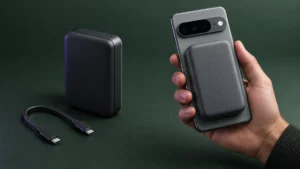
Magnetic Qi2 power banks work best when the phone has a native Qi2 magnet ring (Pixel 10 Pro Fold) or a well-seated magnetic case on a Qi2 Ready model. The added weight of a power bank pressing against a foldable’s rear surface creates alignment drift risk, particularly on book-fold models where the hinge creates a raised ridge that interrupts flat contact. Use the lowest-profile compatible case possible and confirm that the power bank’s magnet strength is sufficient to bridge any ridge created by the hinge design. Avoid using the phone intensively — especially gaming or video — while a magnetic power bank is attached. The combination of battery-to-battery heat generation and screen-on drain accelerates the foldable’s own thermal protection triggers faster than charging alone. For a look at how magnetic grip-and-charge accessories handle this trade-off, see our review of the Belkin Stage PowerGrip.
Check a Qi2 magnetic power bank on Amazon
Heat note: foldables can throttle sooner during magnetic power-bank charging; avoid heavy screen-on use while charging.
Magnetic Car Mounts
For native Qi2 foldables (Pixel 10 Pro Fold), a Qi2-certified magnetic car mount provides both secure retention and in-car wireless charging. A fan-cooled mount is worth considering for foldable phones specifically — the combination of direct sunlight through a windshield, continuous navigation app use, and active wireless charging current generates more heat than any of those factors alone. Fan cooling mitigates the risk of thermal throttling during long drives. For Qi2 Ready foldables using a magnetic case, confirm that the car mount’s rated holding force accounts for the phone’s weight — book-fold foldables are meaningfully heavier than clamshell models and flat phones. Do not use the Motorola Razr’s closure magnets alone for car mount retention; use a full wraparound magnetic case instead. For a broader comparison of Qi2 in-car charging options, see our guide to Qi2 magnetic car chargers.

Please check the Amazon product page for the latest price and availability.
Five Questions to Answer Before Choosing a Foldable for Qi2 Charging
- Do you want built-in magnets, or are you willing to use a dedicated magnetic case? If you want to place any Qi2 charger down and snap the phone into position without accessories, only the Pixel 10 Pro Fold supports this today. All Qi2 Ready models require a specific magnetic case as a permanent part of the setup.
- Do you use the S Pen? If yes, and you are considering a Galaxy Z Fold 7, research EMR-shielded cases specifically before deciding. A standard MagSafe-compatible case is not confirmed safe for inner display S Pen use on Galaxy Z Fold models. This is a hardware-level conflict, not a software issue.
- Is wireless charging speed a priority, or is it convenience? At 15W peak on the best available foldables, Qi2 wireless charging is slower than wired fast charging on most flagship phones. If maximum charging speed is the deciding factor, a flat phone with native Qi2 and no heat throttling complications will serve that goal more effectively than a foldable.
- Will you use a magnetic car mount? Book-fold foldables are heavy. Confirm the mount’s magnetic holding force is rated for the phone’s weight. Do not rely on the Motorola Razr’s closure magnets for car mount retention — use a full magnetic case with a proper ring magnet instead.
- Will you use a magnetic power bank regularly? If yes, plan for the heat implications before purchasing. Foldables generate more heat than flat phones under the same charging scenario, and active use while a magnetic power bank is attached compounds this. Charging-only sessions in a stationary environment are the lowest-risk configuration.
How We Researched
This guide is based on manufacturer specifications and official support documentation from Google, Samsung, Motorola, and Oppo, the Wireless Power Consortium’s published Qi2 materials, and recurring community reports gathered from forums including r/GalaxyFold, r/GooglePixel, r/razr, and r/Android. We have not conducted hands-on lab testing. Wireless charging speeds, Qi2 designations, and compatibility claims are attributed to official sources, and any environment-specific behavior — such as heat throttling, S Pen dead zones, or reduced charging power — is identified as a community report rather than a product-wide verdict. Where only a single thread supported a claim, that point was either excluded or explicitly qualified. Specifications and availability change over time, so confirm current details on the manufacturer’s official page before purchasing.
Final Verdict: Which Foldable Should You Buy for Magnetic Wireless Charging?
The right answer depends on which part of the Qi2 ecosystem matters most to you and how central wireless charging is to your daily habits.
If native Qi2 with no case required is the priority: The Pixel 10 Pro Fold is the only current option. Its Pixelsnap built-in magnets work on any Qi2-certified charger, pad, or mount without a magnetic case. The confirmed heat throttling is real and worth planning around — charge in cooler environments or in shorter sessions rather than overnight — but it does not eliminate the phone from consideration. It is the only foldable that delivers the snap-and-charge experience of native Qi2 without accessory dependencies.
If you want Samsung’s foldable and do not use the S Pen heavily: The Galaxy Z Fold 7’s Qi2 Ready designation works as advertised with the right magnetic case. Prioritize an EMR-shielded case even if you use the S Pen only occasionally. The 15W wireless charging ceiling matches the Pixel 10 Pro Fold. If you use the S Pen as a core part of your workflow and plan to use a magnetic case for Qi2, this is a genuine hardware conflict — not a software issue that Samsung can resolve with an update.
If the clamshell form factor is the deciding feature: The Galaxy Z Flip 7 or Z Flip 7 FE are Qi2 Ready via a magnetic case, but the 10W speed ceiling means you are accepting a charging performance trade-off in exchange for the compact form factor. That is a fair trade if the clamshell design is your primary motivation.
If none of the above foldable options fully fit your needs: A flat flagship phone with native Qi2 will give you faster wireless charging, no S Pen conflicts, no heat throttling complications, and a simpler accessory setup with no case dependency. The foldable form factor has genuine merits for multitasking, portability, and screen real estate — but if Qi2 wireless charging is your top priority rather than a secondary benefit, a flat phone resolves every problem described in this guide simultaneously.
✅ Buy a foldable for Qi2 if…
- You want the foldable form factor for its own merits and Qi2 is a useful feature on top of that decision.
- You are buying a Pixel 10 Pro Fold and can manage the heat throttling by adjusting your charging habits.
- You are buying a Galaxy Z Fold 7, do not use the S Pen heavily, and are committing to an EMR-shielded magnetic case from the start.
❌ Don’t buy a foldable primarily for Qi2 if…
- Wireless charging performance is your top buying criterion — a flat flagship with native Qi2 is faster, cooler, and involves fewer accessory dependencies.
- You use the S Pen extensively on a Galaxy Z Fold and plan to rely on a standard magnetic case for Qi2 alignment.
- You are considering a Motorola Razr or Pixel 9 Pro Fold specifically for magnetic accessory compatibility — neither supports Qi2 in a reliable, purpose-built configuration.

Comments