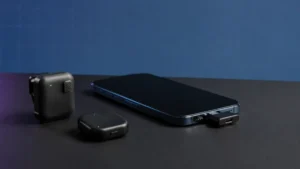
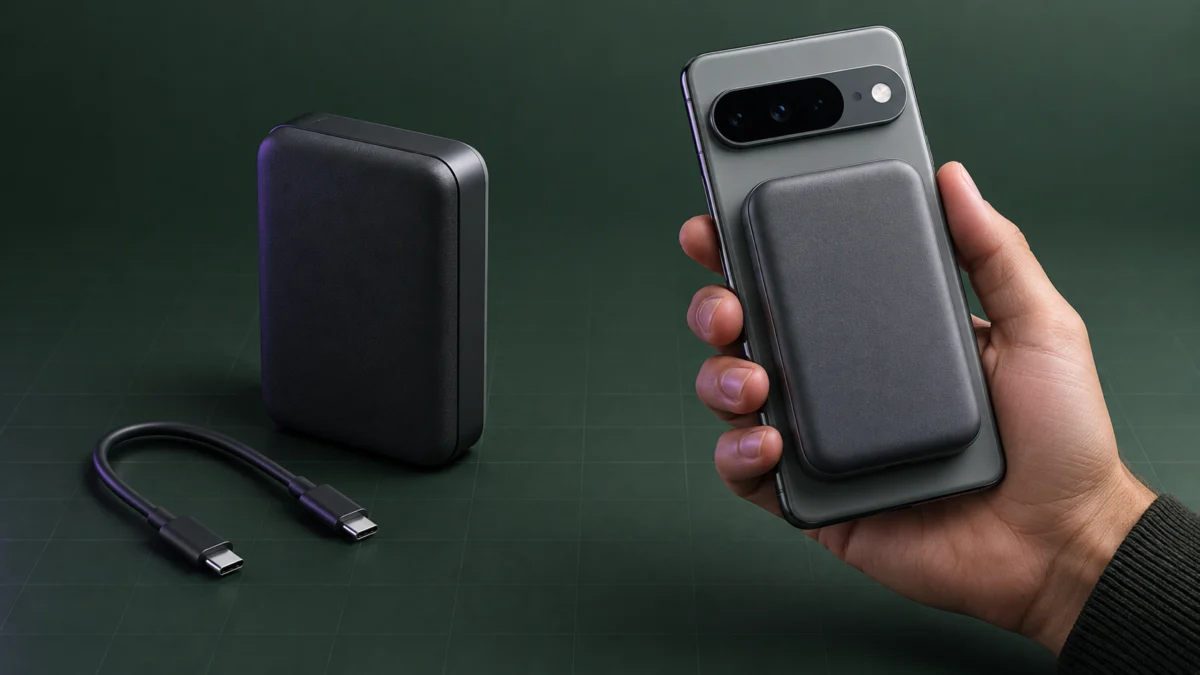
If you want a magnetic pack that snaps onto a Pixel 10 and tops it up on the move, four models are worth your attention. The Anker Nano Power Bank (5K, MagGo, Slim) is the one to carry every day, at a listed 8.6mm thick. The Belkin BoostCharge Slim Magnetic Power Bank 5K with Qi2 is the better 5K choice if you also charge earbuds. For a full day away from an outlet, the UGREEN MagFlow 10000mAh Qi2 25W and the Baseus PicoGo AM52 are the two 10K options, with the Baseus better suited to anyone who expects to fall back to a cable.
Two things decide the rest of this purchase, and both cut against the marketing. A power bank delivers roughly half its advertised capacity to your phone, which several of these manufacturers state outright on their own spec pages. And Qi2 25W, which only the Pixel 10 Pro XL supports, is barely faster in practice than plain Qi2 15W. Buy for capacity, USB-C output, and heat behavior instead of the wattage on the box.
Quick Picks: The Best Qi2 Power Bank for Your Pixel 10
For most Pixel 10 owners, a 5,000mAh Qi2 pack handles daily top-ups and a 10,000mAh pack covers a full day away from an outlet. Two facts decide the rest: a power bank delivers roughly half its advertised capacity, and Qi2 25W is only marginally faster than Qi2 15W.
| Pick | Capacity | Wireless max | USB-C | Best for | Main drawback |
|---|---|---|---|---|---|
| Anker Nano Power Bank (5K, MagGo, Slim) | 5,000mAh | Qi2 15W | 20W two-way, port only | Everyday pocket carry | Partial charge only |
| Belkin BoostCharge Slim Magnetic Power Bank 5K with Qi2 | 5,000mAh | Qi2 15W | 20W, cable included | Phone plus earbuds at once | Partial charge only |
| UGREEN MagFlow 10000mAh Qi2 25W | 10,000mAh | Qi2.2 25W | 30W built-in cable | Long days, several devices | Heaviest of the four |
| Baseus PicoGo AM52 | 10,000mAh | Qi2.2 25W | 45W built-in cable | Wired-first users | Thicker than the 5K packs |
- What your Pixel 10 model can actually use
- The four packs in detail
- 5K vs 10K, and Qi2 vs USB-C
- Compatibility, heat, and safety checks
Before You Buy: What Each Pixel 10 Model Can Actually Use
Google lists Qi2 wireless charging at up to 15W on the Pixel 10, 10 Pro, and 10 Pro Fold, and up to 25W on the Pixel 10 Pro XL only. Certification matters more than that number: older Qi chargers without Qi2 drop these phones to around 5W.
| Model | Qi2 wireless maximum | Battery (typical) |
|---|---|---|
| Pixel 10 | Up to 15W | Not cited here |
| Pixel 10 Pro | Up to 15W | Not cited here |
| Pixel 10 Pro Fold | Up to 15W | 5,015mAh |
| Pixel 10 Pro XL | Up to 25W | 5,200mAh |
Google states that Pixel 10 phones support Qi2, and that older Qi1.x chargers will still work but charge at up to 5W. Android Authority’s testing put real numbers on that gap: on 10W and 15W Qi chargers carrying Extended Power Profile certification, a Pixel 10 Pro and Pro XL settled at an effective rate of roughly 3.6W, because the phones look for the Qi2 magnetic handshake and fall back to the basic profile rather than to EPP when they do not find it. The same publication reports numerous user complaints about older Qi pads charging a Pixel 10 slowly, intermittently, or not at all, with in-car pads a recurring theme. That does not mean every Qi pad behaves this way, but it does mean a genuine Qi2 pack is the safer purchase.
This is also why “MagSafe compatible” and “Qi2 certified” are not interchangeable. A MagSafe compatible pack may simply have the right magnet ring. Qi2 certification is what confirms support for the magnetic power profile your Pixel 10 looks for. All four packs below are described by their manufacturers as Qi2 or Qi2.2, and there is a way to verify that independently, which we cover in the safety checks.
One more point worth clearing up before you shop. A Qi2 power bank is not a replacement for the Battery Share feature older Pixels used to send power out to other devices. Google’s support documentation lists Battery Share as available on Pixel 5 through Pixel 9 Pro XL, and the Pixel 10 series is not on that list. A power bank is a separate portable source of power, not a way to restore that feature. If you are still looking for the missing Battery Share setting, see why it is not available on the Pixel 10 series.
The Four Qi2 Power Banks We Shortlisted
We shortlisted four packs against three conditions: the manufacturer states Qi2 or Qi2.2 support in its own specifications, the pack has a USB-C output that can charge a second device, and the manufacturer publishes both wireless and wired output ratings rather than a headline capacity number alone.
One thing these four do not all share is a published effective-capacity figure. Anker, UGREEN, and Baseus each state on their own product pages how much of the advertised capacity actually reaches a device, and those disclosures drive the capacity section below. Belkin’s product page publishes output ratings, dimensions, and a compatibility list, but no effective-capacity or efficiency figure that we could find.
Anker Nano Power Bank (5K, MagGo, Slim)
The Anker Nano Power Bank (5K, MagGo, Slim) is the pick when thickness matters most. Anker lists it at 8.6mm and 122g with 15W Qi2 wireless output, 20W two-way USB-C, and explicit Google Pixel 10 series compatibility on its own product page.
Anker also publishes the number most brands leave out: because of losses in the cells and conversion circuitry of roughly 30% to 45%, it says a fully charged 5,000mAh pack typically supplies about 2,750mAh to 3,500mAh to your device. Anker describes graphene heat dissipation and dual temperature sensors intended to hold the surface below about 40°C in use. The pack has a single USB-C port, so wired output and wireless output share one budget rather than running at full speed together.
- Buy if you want the pack you will actually carry every day, and a partial top-up is enough.
- Buy if you use a thin magnetic case, since Anker advises against cases thicker than 2.5mm.
- Don’t buy if you need a full charge from empty on a Pixel 10 Pro XL.
- Don’t buy if you regularly charge two devices at full speed simultaneously.

Please check the Amazon product page for the latest price and availability.
Belkin BoostCharge Slim Magnetic Power Bank 5K with Qi2
The Belkin BoostCharge Slim Magnetic Power Bank 5K with Qi2 is the pick if you charge two things at once. Belkin states it powers a phone on the wireless pad and a second device over USB-C simultaneously, and lists all four Pixel 10 models as compatible.
Belkin gives 15W Qi2 wireless and 20W USB-C, measures the pack at 102 × 72 × 11mm, and includes a 60cm USB-C to USB-C cable in the box, which matters because the wired path is the faster one. The company also lists pass-through charging and states the design is TSA carry-on compliant. It is a couple of millimeters thicker than the Anker, and that is the trade for the second charging path and the bundled cable.
- Buy if you want to charge a Pixel and earbuds from one pack at the same time.
- Buy if you would rather not buy a separate cable.
- Don’t buy if absolute thinness is your priority.
- Don’t buy if you need more than a partial top-up on a long day.

Please check the Amazon product page for the latest price and availability.
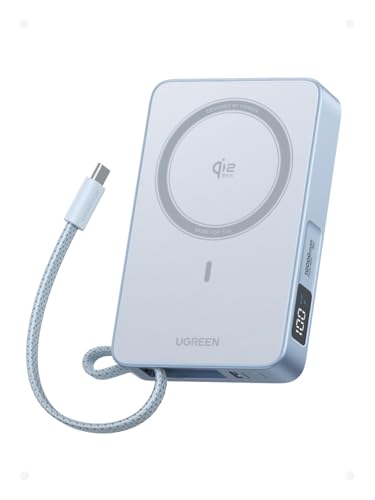
UGREEN MagFlow Magnetic Wireless Power Bank 10000mAh Qi2 25W
The UGREEN MagFlow 10000mAh Qi2 25W is the pick for a full day out with more than one device. UGREEN publishes an unusually honest spec sheet: 10,000mAh cell, 5,600mAh rated capacity, 70% wireless charging efficiency, Qi2.2 up to 25W, and a built-in 30W USB-C cable.
Those two figures together are the clearest answer to the capacity question anywhere in this guide. A 5,600mAh rated capacity is already close to a Pixel 10 Pro XL’s 5,200mAh typical battery before wireless losses are applied, and UGREEN’s own 70% wireless figure explains why one charge is what you get. The pack supports three devices at once across two USB-C paths and the wireless pad, carries a battery percentage display, and is listed at 110.8 × 70 × 21mm and 254g. That is the heaviest option here by a clear margin.
- Buy if you are away from an outlet all day and carry earbuds or a watch as well.
- Buy if you want a numeric battery readout rather than indicator lights.
- Don’t buy if pocket carry matters, since 254g is noticeable on the back of a phone.
- Don’t buy if you expect two full Pixel 10 charges from it.
Please check the Amazon product page for the latest price and availability.
Baseus PicoGo AM52 Qi2.2 Magnetic Power Bank with Built-in Cable
The Baseus PicoGo AM52 is the pick if you want wireless convenience but expect to fall back to a cable. Baseus rates the built-in USB-C cable at 45W against 25W wireless, and its own FAQ names the Pixel 10 Pro XL as the Qi2.2 25W model.
That FAQ is worth quoting in substance because it is unusually specific for a manufacturer: Baseus states that Qi2.2 25W charging applies to recent iPhones and the Google Pixel 10 Pro XL, while Qi2 and Qi devices cap out at 15W. It also states that cell and circuit losses of 35% to 45% leave roughly 5,500mAh to 6,500mAh of usable power from the 10,000mAh cell, and recommends not using the phone while it charges wirelessly in order to limit heat. At 45W, it carries the highest listed wired output in this shortlist.
- Buy if you would use the cable most of the time and the magnet occasionally.
- Buy if you want the highest listed wired output of the four.
- Don’t buy if you want the slimmest possible pack.
- Don’t buy if you need a numeric capacity display, since this model uses indicator lights.

Please check the Amazon product page for the latest price and availability.
5K vs 10K, Qi2 vs USB-C: Which Setup Actually Fits You?
Buy capacity for how long you are away from an outlet, not for how many charges the box implies. The manufacturers that publish the figure put the loss at 30% to 45%, so a 10,000mAh pack fills one Pixel 10 and a 5,000mAh pack adds roughly two thirds.
Android Authority ran this to conclusion on Pixel 10 hardware. Charging a Pixel 10 Pro XL from empty over Qi2.2 with the UGREEN 10,000mAh pack, the pack reached 0% while the phone stopped at 99%. The same pack over its USB-C cable finished the job in less time and still had 13% left. The table below is that publication’s measured data, not ours.
| Pack and phone | Method | Duration | Pack remaining | Peak temp |
|---|---|---|---|---|
| UGREEN 10,000mAh + Pixel 10 Pro | Qi2 15W | 163 min | 3% | 42°C |
| UGREEN 10,000mAh + Pixel 10 Pro | USB-C 30W | 99 min | 18% | 40.5°C |
| UGREEN 10,000mAh + Pixel 10 Pro XL | Qi2.2 25W | 122 min, reached 99% | 0% | 39.5°C |
| UGREEN 10,000mAh + Pixel 10 Pro XL | USB-C 30W | 107 min | 13% | 37°C |
A second round of testing by the same author covered the wattage question directly. A Pixel 10 Pro XL took 77 minutes to fill over USB-C but 135 minutes over Qi2 25W using Google’s own Pixelsnap Charger with Stand. The wireless session started near its rated power for a few minutes and then settled at around 10W for the remainder, while the wired session held a high rate for more than 30 minutes. Temperature followed the same pattern: the wired charge peaked near 38.7°C and dropped away after half an hour, while the wireless charge sat around 38°C for most of two hours.
That is why we do not tell Pixel 10 Pro XL owners to pay a premium for Qi2 25W. Because the rate collapses to roughly 10W within minutes, a 25W pack and a 15W pack spend almost all of the charge doing the same thing. Android Authority reached the same conclusion and suggested taking the cheaper 15W option when the price gap exceeds about twenty dollars. Spend the difference on capacity, on a better USB-C output, or on a pack you will actually carry.
There is one forward-looking exception. Google’s current specifications list every Pixel 11 model as Qi2.2 certified at up to 25W, so if you expect to move to that generation, a 25W pack carries over more usefully than a 15W one. That is a reason to prefer 25W at similar prices, not a reason to pay a large premium today.
Matching the pack to the day is more useful than any of this. A 5,000mAh pack is a top-up device: expect it to take a Pixel 10 to somewhere around two thirds and to disappear into a pocket while doing it. A 10,000mAh pack is a full-day device: expect one complete charge and very little in reserve. If you also charge earbuds, the Belkin and the two 10K packs can run a second device over USB-C while the phone sits on the pad. And if you mostly want speed, use the cable. The measured data shows the wired path finishing faster, running cooler, and drawing less from the same cell.
One decision sits outside all of this. If the pack would mostly live on a desk or a bedside table, a portable battery is the wrong product. Choose a wall-powered Qi2 charger instead if portability is not your priority.
Compatibility, Heat, and Safety Checks Before You Buy
Three checks prevent most disappointment: confirm the pack is genuinely Qi2 certified rather than only described as MagSafe compatible, confirm your case is thin and magnetic, and confirm the model you are buying is not covered by an active safety recall.
Verify the certification. Google’s support documentation points buyers at the Wireless Power Consortium’s certified product database and gives a simple rule: for Qi2 compatibility, check that the product’s version number in the database starts with a 2. That is a stronger signal than any phrase on a retail listing.
Check the case. Google states that magnetic attachment and wireless charging work best with no case or a case designed for Qi2, that non-magnetic cases produce weak attachment and unreliable charging, and that thick or metallic cases including those with magnets or ring holders can slow or stop charging entirely. Anker advises against cases thicker than 2.5mm on its 5K pack. Removing the case for a wireless top-up is a legitimate fix, not a workaround.
Expect heat, and expect pauses. Google states plainly that if the phone gets too warm it may pause charging to protect the battery, resuming once it cools. Baseus makes the related point that using the phone during a wireless charge adds heat on top of the conversion losses. If your pack seems to stop halfway through, that behavior is more likely thermal management than a fault.
Check for recalls by model number. The US Consumer Product Safety Commission has an active recall covering ESR HaloLock wireless power banks in models 2G505, 2G520, 2G505B, and 2G512B, on the basis that the lithium-ion battery can overheat and ignite. The CPSC notice records twenty reports of fire or explosion and about $30,000 in property damage, with no injuries reported, and the remedy is a refund. Those units were sold through major online retailers between September 2022 and July 2025, so they can still turn up secondhand. This recall covers specific models from one distributor and should not be read as a verdict on that brand’s other products or on magnetic power banks generally. If you own one, the CPSC directs owners to stop using it and to dispose of it through a household hazardous waste facility rather than ordinary household trash or a store battery bin.
Two limits are worth stating plainly. Manufacturer wattage ratings describe what a device can deliver under favorable conditions, not what your phone will sustain, and a power bank cannot be relied on as an uninterrupted power source for anything that matters. Check the manufacturer’s own specifications and airline rules before you travel with a lithium-ion pack, and follow the manufacturer’s guidance rather than a general article if a pack ever swells, discolors, or becomes uncomfortably hot.
How We Researched
This article is based on manufacturer documentation, official Google Pixel support materials, US Consumer Product Safety Commission recall notices, and published third-party charge testing. We have not conducted hands-on lab testing. Wattage limits by Pixel model, Battery Share availability, case guidance, and thermal pausing behavior come from Google’s official support pages. Product specifications come from each manufacturer’s own pages; Anker, UGREEN, and Baseus publish effective-capacity or efficiency figures, while the Belkin product page does not. All charge durations, remaining-capacity readings, and temperature figures are measured results published by Android Authority and are attributed as such; they are not our own measurements. Where a published test used a different model number from the product we shortlisted, we have not carried those results across. We did not use community forum reports as evidence in this guide, because we could not confirm the same reports across multiple independent threads.
FAQ
Will a 10,000mAh power bank charge my Pixel 10 twice?
No. Manufacturers state losses of roughly 30% to 45% between the cell and your phone, and UGREEN publishes a rated capacity of 5,600mAh for its 10,000mAh pack alongside a 70% wireless charging efficiency figure. In published testing, a 10,000mAh pack was close to empty after a single full Pixel 10 Pro or Pro XL charge.
Is a MagSafe-compatible power bank the same as a Qi2 power bank for the Pixel 10?
Not necessarily. A MagSafe-compatible pack may only match the magnet layout. Qi2 certification is what confirms the magnetic power profile a Pixel 10 looks for, and Google’s documentation notes that non-Qi2 chargers fall back to about 5W. Check the Wireless Power Consortium database rather than the retail description.
Does a Qi2 power bank restore Battery Share on the Pixel 10?
No. Battery Share sent power out from the phone to other devices, and Google’s support documentation lists it as available on Pixel 5 through Pixel 9 Pro XL only. A magnetic power bank is an independent portable power source that charges your Pixel; it does not add an outbound charging feature to the phone.
Final Recommendation
Our recommendation splits by what you value. If magnetic convenience is the point, take a 5,000mAh Qi2 pack and accept a partial top-up. If speed and efficiency matter more, take a 10,000mAh pack with a strong USB-C output and treat the wireless pad as a bonus.
In practice that means the Anker Nano Power Bank for daily carry, the Belkin BoostCharge Slim if you want the second charging path and the bundled cable, the UGREEN MagFlow if you want a published rated-capacity figure and a readable percentage display, and the Baseus PicoGo AM52 if the cable is your primary tool and the magnet is a convenience. Pixel 10 Pro XL owners should not treat Qi2 25W as the deciding factor. It is a tiebreaker at similar prices and a modest hedge toward the Pixel 11 generation, not a performance upgrade you will feel.