
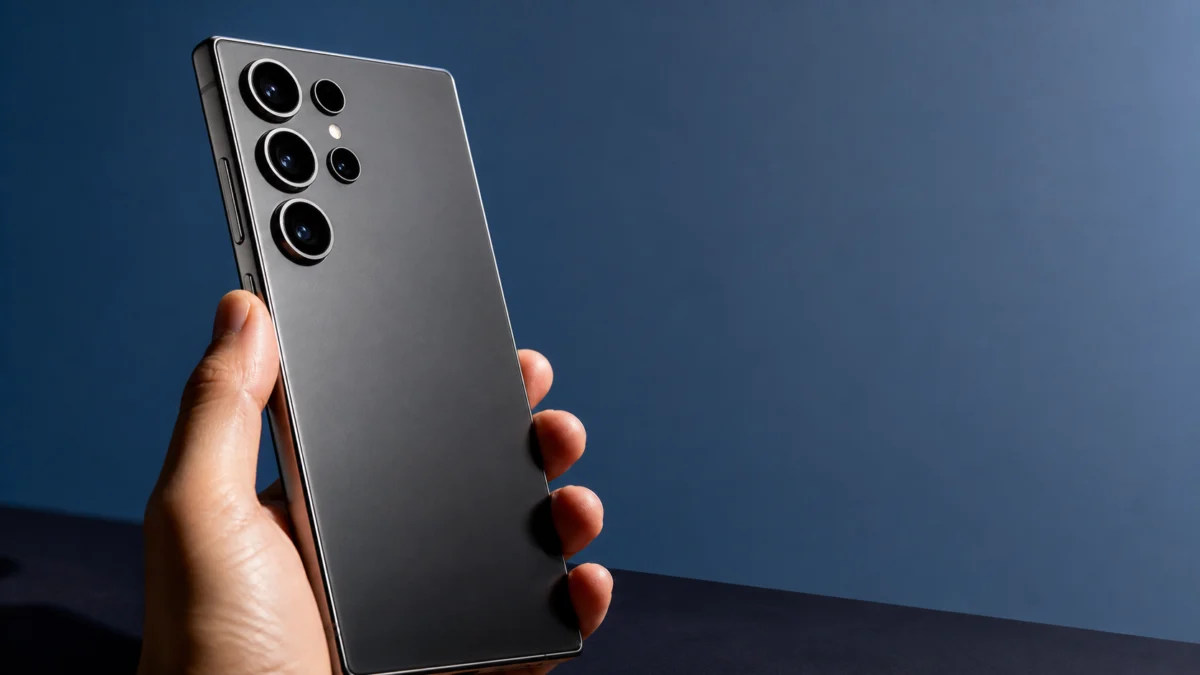
Short answer: If your Galaxy S26 Ultra is draining fast, work through these in order: (1) install the latest One UI 8.5 security patch, (2) turn off proactive Galaxy AI features such as Now Brief and Now Nudge, (3) send background-heavy apps to Deep Sleep, and (4) give the phone about 14 days to recalibrate after any update. Most cases are fixed in software. Move to a hardware check only if the phone still loses more than 15% overnight while idle, or if the Samsung Members diagnostic reports a “Weak” or “Bad” battery. Use the symptom guide below to jump to the most likely cause for your situation.
| Symptom | What to check first |
|---|---|
| Battery drops fast overnight | Always On Display, background apps, Galaxy AI listeners |
| Drain started after an update | Software update level, system cache wipe, 14-day recalibration |
| Phone runs warm | 5G / location, camera background activity, background sync |
| Drains while sitting idle | Deep Sleep apps, Adaptive power saving |
| New or just-restored phone | Setup indexing, restore method, first 48 hours |
Your Galaxy S26 Ultra is draining its battery far faster than Samsung’s official figures suggest. You are not imagining the problem, and you are not alone. Across Reddit communities including r/GalaxyS25 and r/samsung, and within Samsung’s own developer forums, thousands of users have documented identical symptoms: a fully charged device collapsing to 15% within two hours of standby, screen-on time (SOT) swinging unpredictably between 4 and 8 hours from one day to the next, and localized heat concentrating in the upper-left corner of the chassis near the camera module — even when no demanding applications are running.
The root cause is not a single flaw. It is a layered conflict between the Agentic Galaxy AI subsystems introduced in One UI 8.5, background application wake-locks that bypass Android’s Doze mechanism, older firmware behavior that may be refined through later updates, and — in a minority of cases — a genuine hardware defect in the lithium-ion cell itself. This guide separates the two questions: first why the battery is draining, then how to fix it, in order of likelihood — from a 30-second settings change to a factory reset — and establishes the precise threshold at which software troubleshooting must yield to professional hardware repair.
If you are on an older security patch: earlier firmware can include device-stability, camera-processing, or power-management issues that are later refined through updates. Installing the latest available One UI 8.5 security patch is the highest-priority step in this guide.
Why Is Your Galaxy S26 Ultra Draining So Fast? The Four Main Causes
In most reports, the drain comes from one of four overlapping causes: proactive Galaxy AI features keeping the chip awake, background apps bypassing Doze, older firmware with unresolved stability or power-management issues, or a magnetic-case charging conflict. A failing battery cell is the less common fifth possibility. Each is covered below in order of likelihood.
The Galaxy S26 Ultra ships with a 5000 mAh battery and officially targets up to 31 hours of video playback. The EU energy-label record for the SM-S948B/DS model lists 55 hours of battery endurance per cycle under the EU standardized test. Under real-world conditions, a healthy device should achieve 8 to 10 hours of screen-on time. If your device is consistently falling below this threshold, one or more of the following four causes is responsible.
Cause 1: Proactive Galaxy AI Features Keep the Chip Awake
The S26 Ultra introduces “Agentic AI” — a proactive intelligence model that anticipates user needs rather than waiting to be invoked. The practical consequence is that features including Now Nudge (OCR), Now Brief (background data aggregation), Circle to Search (persistent gesture listener), and Live Translate (active memory translation modules) keep the Neural Processing Unit (NPU) and memory controller continuously active. This prevents the System-on-Chip (SoC) from entering its lowest power states during standby. When the device operates in a low-signal area, the modem simultaneously expends significant energy maintaining the uplink to Samsung and Google cloud servers for AI processing — compounding the drain.
Cause 2: Background Apps Bypass Android’s Doze Mode
Android’s Doze mechanism is designed to suspend background processes and batch network requests. Specific applications on the S26 Ultra are bypassing these restrictions. According to forensic data aggregated from global developer communities, Samsung Health is a frequent offender — it continuously polls the pedometer, gyroscope, and accelerometer sensors, and maintains a persistent Bluetooth Low Energy (BLE) connection with Galaxy Watch devices, interrupting the CPU’s sleep cycle hundreds of times per hour. Google Play Services logging errors and Samsung Knox security scanning loops have also been identified as sources of parasitic drain that keeps the cellular radio perpetually active.
Cause 3: Older Firmware With Unresolved Power-Management Issues
Some earlier Galaxy S26 Ultra firmware builds have been associated with user reports of post-update battery drain and camera-processing anomalies. Because public changelogs are often broad, treat this category as a software-maintenance step rather than proof that one named build is the cause. Install the latest available patch before judging battery life or moving to reset-level troubleshooting.
Cause 4: Magnetic Cases and Maximum Screen Brightness
The Galaxy S26 Ultra supports 25W wireless charging but does not include the built-in magnetic alignment rings used by the Qi2 standard, reportedly to avoid electromagnetic interference with the S Pen’s Wacom digitizer. Users who compensate by buying third-party magnetic cases can introduce a separate problem: the embedded magnets continuously trigger the device’s internal Hall sensor. On a wireless charging pad, this confuses the induction handshake, dropping charging efficiency and generating sustained heat that stresses the lithium-ion cell and causes the Power Management IC (PMIC) to throttle charging — producing phantom drain while the device is ostensibly on charge.
A secondary display-related factor: if perceived screen luminance feels dim, users tend to push brightness to maximum. An AMOLED panel operating at very high brightness consumes power far faster than at moderate levels, which can mask the true cause of the drain.
Which Cause Matches Which Fix?
Use this map to jump straight from the cause that matches your symptoms to the fix that addresses it.
| Cause | What it does to the battery | Where it is fixed |
|---|---|---|
| Proactive Galaxy AI features | Keeps the NPU and modem active during standby | Fix 2 |
| Background app wake-locks | Interrupts Doze and keeps the cellular radio active | Fix 3 |
| Older firmware | Leaves stability and power-management issues unresolved | Fix 4, then Fix 5 |
| Magnetic case on a wireless pad | Confuses the induction handshake and generates heat | Quick check 5 (remove the case before charging) |
| Display left at maximum brightness | Drains the largest single power consumer on the device | Fix 1 |
| Failing battery cell (less common) | Cannot hold charge regardless of settings | Hardware check |
How Do You Fix It? Start With These Five Quick Checks
Run these five checks before anything else. Each takes under two minutes, and together they cover the update level, the two proactive Galaxy AI features, adaptive power saving, per-app background usage, and the magnetic-case charging conflict. Check off every point before concluding that a deeper fix is required.
Exact menu names and paths reflect One UI 8.5 and may differ slightly by One UI version, carrier build, or region.
- Go to Settings > Software update and confirm your device is running the latest available security patch. If an update is offered, install it immediately.
- Go to Settings > Galaxy AI and disable Now Nudge and Now Brief.
- Go to Settings > Battery > Power saving, tap the three-dot menu, and enable Adaptive power saving.
- Go to Settings > Battery and tap the discharge graph to find any app showing high background usage relative to active usage.
- If you use a third-party magnetic case with a Qi2 wireless charging pad, remove the case before charging.
If none of the above produces an improvement within 24 hours, continue to the six detailed fixes below. Samsung states that an Adaptive Battery calibration period of up to 14 days follows any major firmware update — if your drain began right after an update and is gradually improving, the system may be self-correcting.
Fix 1: Change These Three One UI Battery Settings
These three adjustments address the baseline power management configuration and should be applied before any other fix.
Switch to the Light Performance Profile
- Open Settings.
- Tap Device care (or Battery, depending on your One UI build).
- Tap Performance profile.
- Select Light.
This caps CPU clock speed and prioritizes thermal efficiency over peak burst performance. Game Booster governs gaming performance independently, so high-framerate rendering is not affected by this change.
Enable Adaptive Power Saving
- Go to Settings > Battery > Power saving.
- Tap the three-dot menu in the upper right corner.
- Select Adaptive power saving and toggle it ON.
The system’s machine learning will then automatically drop the display refresh rate and suspend non-essential background synchronization during periods of historically low interaction, such as overnight.
Adjust Display Timeout and Always On Display
- Go to Settings > Display.
- Confirm Adaptive brightness is toggled ON.
- Set Screen timeout to 15 or 30 seconds.
- Go to Settings > Lock screen and AOD.
- Set Always On Display to Tap to show or turn it fully OFF.
The 6.9-inch Dynamic AMOLED 2X panel is the largest single power consumer on the device. Reducing the time it remains lit during inactivity produces an immediate, noticeable reduction in daily discharge.
Fix 2: Turn Off Galaxy AI Background Listeners
If you do not actively use the proactive AI features, disabling them removes the most significant source of persistent NPU polling and modem wake-locks on the S26 Ultra.
Disable Now Nudge and Now Brief
- Go to Settings > Galaxy AI.
- Tap Now nudge and toggle it OFF. This stops the OCR pipeline that continuously analyzes the screen buffer for actionable suggestions.
- Return to the Galaxy AI menu and tap Now brief.
- Disable the individual content category toggles (weather, schedule, health) to stop background data aggregation.
Force On-Device AI Processing
- In Settings > Galaxy AI, scroll to the bottom of the screen.
- Toggle Process data only on device to ON.
AI tasks will then execute using the on-board NPU only, which removes the battery cost of maintaining a persistent cellular uplink to cloud servers for AI processing. The trade-off is a potential reduction in the complexity of generative outputs — an acceptable compromise for users prioritizing battery longevity.
Disable Circle to Search (If Unused)
- Go to Settings > Display > Navigation bar.
- Toggle off Circle to Search.
- Go to Settings > Apps > Choose default apps > Digital assistant app.
- Toggle off Analyze on-screen images.
Fix 3: Stop Background Apps From Draining Power in Standby
Open the per-app breakdown under Settings > Battery, then move the worst background offenders to Deep Sleep. Samsung Health, rarely used social media apps, and background syncing utilities are the most frequently reported offenders. Deep Sleep stops them from syncing or sending notifications until you launch them, so apply it selectively.
Identify Which Apps Are Draining in the Background
- Go to Settings > Battery.
- Tap directly on the battery discharge graph.
- Review the per-app breakdown. Flag any application showing disproportionately high Background usage relative to its Active usage time. Samsung Health, rarely used social media apps, and background syncing utilities are the most frequently reported offenders.
Move Problem Apps to Deep Sleep
- Go to Settings > Battery > Background usage limits.
- Confirm Put unused apps to sleep is enabled.
- Tap Deep sleeping apps.
- Tap the + icon in the top right corner.
- Select the offending applications and tap Add.
Apps placed in Deep Sleep are moved to Android’s most restricted standby bucket. They lose access to the JobScheduler and AlarmManager APIs, which means they will not receive push notifications or sync data unless you actively launch them. Apply this selectively — do not deep sleep apps you rely on for real-time alerts.
Fix 4: Install the Latest One UI 8.5 Security Patch
If your device is running an older patch level, updating can address security, device-stability, camera-processing, and power-management fixes included by Samsung or your carrier. It also removes older firmware from the troubleshooting path before you move to cache wiping or reset-level fixes.
- Go to Settings > Software update.
- Tap Download and install.
- If an update is available, allow it to download and install fully before evaluating battery behavior.
After updating, allow a minimum of 14 days before drawing conclusions about battery performance. Samsung states that the Adaptive Battery machine learning system resets following a major firmware update and needs this period to relearn usage patterns and re-optimize power allocation.
Fix 5: Wipe the System Cache Partition After an Update
Major One UI updates — particularly the transitions across One UI 7.0, 8.0, and 8.5 — can produce “dirty installs” where legacy cache data conflicts with new system instructions. Wiping the system cache removes these obsolete files without deleting user data, photographs, or installed applications.
Before starting: on current One UI builds, this process may require connecting the device to a PC or laptop via USB-C; a standard wall charger may not trigger the hardware handshake required for Recovery Mode.
- Power the Galaxy S26 Ultra off completely.
- Connect the device to a PC or laptop via a USB-C cable.
- Press and hold the Volume Up and Power (Side) buttons simultaneously.
- Release the Power button when the Samsung logo appears, but keep holding Volume Up until the Android Recovery menu appears.
- Use Volume Down to highlight Wipe cache partition. Press Power to select it.
- Navigate to Yes and confirm.
- Once complete, highlight Reboot system now and press Power.
After the reboot, allow the same 14-day calibration window described in Fix 4. Avoid aggressive settings changes during this period — doing so disrupts the Adaptive Battery model and prolongs calibration.
Fix 6: Factory Reset the Phone (Last Resort)
A factory reset is the appropriate next step if the device continues to drain more than 15% overnight while completely idle (screen off, disconnected from charger), or if SOT remains consistently under 4 hours during standard non-gaming use on Wi-Fi — after completing Fixes 1 through 5 and waiting through the 14-day calibration period.
Before Resetting
Back up all critical data — photos, documents, and contacts — to a secure cloud service or an external drive.
Execute the Reset
- Go to Settings > General Management > Reset > Factory Data Reset.
- Confirm the prompt and allow the device to fully format its internal storage.
The Smart Switch Warning
Upon rebooting, avoid using Samsung Smart Switch to restore your previous backup. Restoring via Smart Switch can port over the same corrupted system files, broken application permissions, or rogue background processes that caused the original drain. Set the device up as a new phone and manually sign into accounts and download apps from the Google Play Store.
If battery drain persists on a clean installation with no third-party applications installed, the device most likely has a hardware defect and software troubleshooting is no longer applicable.
How Do You Know the Drain Is a Hardware Problem?
Treat the drain as hardware rather than software if any of the four signs below applies. Stop software troubleshooting at that point and visit an authorized Samsung service center.
- Diagnostic failure: The Samsung Members app returns a “Weak” or “Bad” battery health status. Run the diagnostic via Samsung Members > Support > Phone diagnostics > Battery status.
- Physical chassis deformation: Any swelling, bulging, or separation of the back glass panel. This indicates a dangerous electrochemical failure and a potential fire hazard — do not charge the device and seek service immediately.
- Voltage collapse: The device shuts down forcibly when the battery indicator reads 15% or higher. This signals that the degraded cell can no longer sustain the minimum voltage required by the SoC under load.
- Cycle limit reached: The EU energy-label record for the SM-S948B/DS model lists battery endurance in cycles at 1,200. Under EU Regulation 2023/1669, that metric means the number of charge/discharge cycles until usable capacity reaches 80% of rated capacity. Beyond its rated cycle life, hardware replacement is the only viable solution.
How Do You Get a Battery Replacement Under Warranty?
Understanding the warranty structure before visiting a service center prevents unnecessary costs.
Standard manufacturer warranty: Samsung replaces a battery free of charge if it fails to hold a charge or shows a manufacturing defect within the first 12 months of ownership. Standard degradation from normal use is not covered.
Samsung Care+: Enrollment must usually be completed within a set window after device purchase. Samsung Care+ covers repairs for mechanical breakdowns, which can include battery replacements when capacity degrades past acceptable thresholds. Repairs are performed by certified technicians using OEM parts, and the IP68 water resistance seal is restored after service.
Claim strategy: When opening a repair ticket, present the results of your Samsung Members diagnostic test. If the issue is a sudden capacity drop — a manufacturing defect — rather than accidental damage such as a cracked screen, communicate this clearly to the service representative. Describing the failure as a mechanical breakdown helps the claim process correctly.
How We Researched
This article is based on Samsung’s official support documentation for Now nudge and Galaxy AI settings and battery management, Samsung’s official Galaxy S26 Ultra specifications, EU energy-label records for hardware baselines, and user reports aggregated from r/GalaxyS25, r/samsung, and r/samsunggalaxy. No physical device testing was conducted by Fixory. All troubleshooting steps reflect official OEM guidance and community-reported procedures.
Frequently Asked Questions
Why is my Galaxy S26 Ultra battery draining so fast?
In most reports the cause is software: proactive Galaxy AI features keeping the chip awake, background apps bypassing Doze, older firmware with unresolved stability or power-management issues, or a magnetic-case charging conflict. A failing battery cell is a less common cause. Start by updating to the latest patch and disabling Now Brief and Now Nudge.
Does turning off Galaxy AI actually save battery?
Yes. Disabling proactive features such as Now Nudge and Now Brief, and enabling “Process data only on device,” removes a major source of persistent NPU polling and cellular wake-locks. The trade-off is fewer proactive AI suggestions.
How long should I wait after an update before judging battery life?
About 14 days. Samsung states the Adaptive Battery system resets after a major firmware update and needs roughly two weeks to relearn your usage patterns. Judging battery life before then can give misleading results.
When is the drain a hardware problem rather than software?
Treat it as hardware if, after all six fixes and the 14-day calibration period, the phone still loses more than 15% overnight while idle, SOT stays under about 4 hours in normal use, or the Samsung Members diagnostic returns a “Weak” or “Bad” battery result.
Final Verdict: Getting Your Battery Life Back
The Galaxy S26 Ultra’s battery drain is real, widely reported, and — in most cases — fixable through software. The single most impactful action is installing the latest security patch, which removes older firmware from the troubleshooting path before you change settings or evaluate hardware. Disabling Now Nudge and Now Brief removes the most persistent source of NPU and modem wake-locks, and sending background-heavy apps to Deep Sleep handles the remaining software-layer drain.
The 14-day Adaptive Battery calibration window is not optional — it is the period during which the system relearns your usage patterns after a firmware change. Evaluating the device before this period ends will produce misleading results.
If drain persists after all six fixes and the calibration period, run the Samsung Members battery diagnostic. A “Bad” result means the lithium-ion cell has reached the end of its viable life. Samsung Care+ may cover this under mechanical breakdown — not accidental damage — if you are enrolled. Present the diagnostic result clearly when filing the repair ticket.



Comments