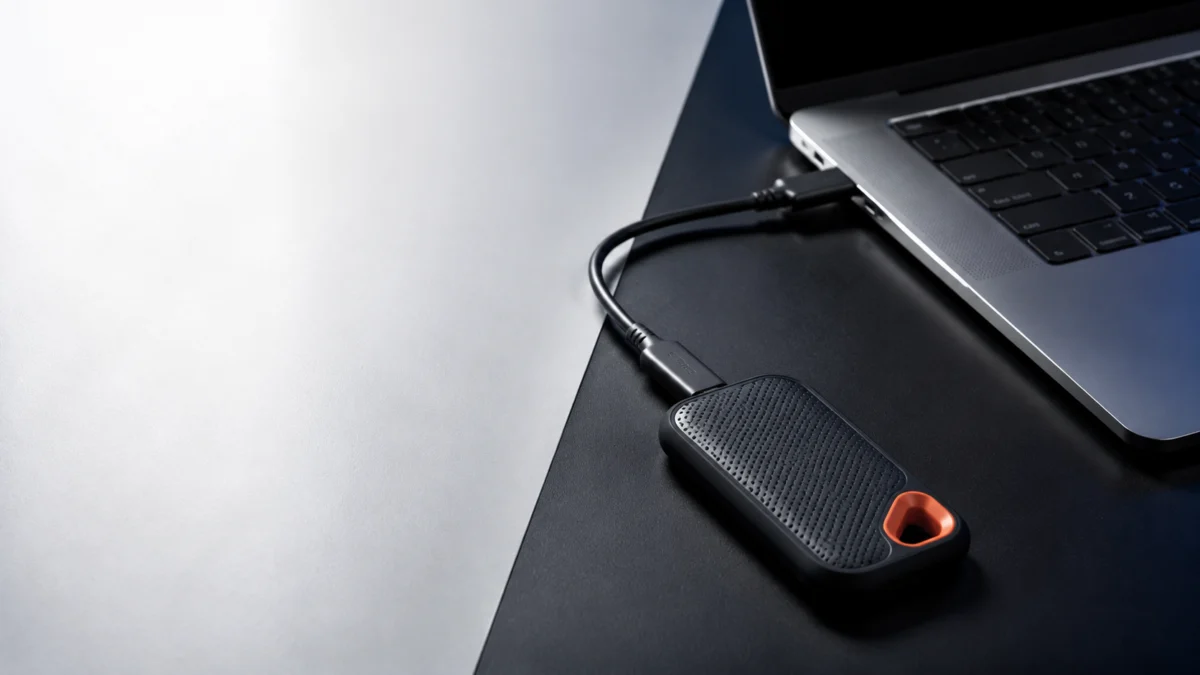
If your SanDisk Extreme Portable SSD V2 (SDSSDE61) transfers files slowly on Windows 11, check the negotiated USB link speed before you change any setting. A steady rate near 40 MB/s strongly suggests that the connection has fallen back to USB 2.0 High-Speed rather than USB 3.2 Gen 2, so verify the USB path before assuming the SSD is failing.
Do not format, initialize, or chase a firmware update first. Formatting and initialization erase data, while any firmware update should be attempted only after irreplaceable files are backed up. Work through the checks below in order instead.
- Identify which of the four slow-transfer patterns you have.
- Confirm your capacity and model number, and back up irreplaceable files.
- Verify the negotiated USB link speed in Windows.
- Compare the bundled cable, a direct port, and a second computer.
- Separate file-level, Windows-level, and sustained-write causes.
- Only then consider firmware, formatting, or a warranty claim.
Which “Slow Transfer” Pattern Do You Actually Have?
“Slow transfer” covers four different symptoms: a long pause before copying starts, a steady low ceiling, a fast start that collapses partway through, and slowness that only affects large batches of small files. Each points to a different cause, so identify yours before changing anything.
Write down what you see before testing anything. The same 50 MB/s reading means different things depending on when it appears.
| Pattern you observe | What it usually points to | Where to start |
|---|---|---|
| Long pause before the copy begins, then normal speed | Something is delaying access to the drive rather than limiting throughput | Adapters, drive sleep and wake behavior, indexing and preview generation |
| Steady low ceiling around 40 MB/s from start to finish | The connection is negotiating a slower USB link than the drive supports | Negotiated link speed, port, cable, adapter |
| Fast at first, then a sharp drop that does not recover | A large sustained write has outrun the drive’s fastest write mode | File size, total transfer volume, drive temperature, free space |
| Only slow with many small files; large single files are fine | Per-file overhead rather than a throughput limit | File count, folder depth, real-time scanning |
According to multiple posts on SanDisk’s official community forum and an independent Windows 11 report, some users of the Extreme Portable SSD have seen a pause of roughly ten seconds before each copy begins, with normal speed once the transfer starts. In those reports the same pause appeared when renaming a file or expanding a folder, which points to a delay in reaching the drive rather than a transfer-rate limit. This does not appear to affect every unit.
Confirm Your Exact V2 Model and Protect Your Data First
The V2 family uses the SDSSDE61 model number across 500GB, 1TB, 2TB, 4TB, and 8TB capacities, while the Extreme PRO uses SDSSDE81. Capacity decides which official support and firmware material applies to you, so read the label before you follow any guide, and copy irreplaceable files first.
The model number is printed on the drive and on the retail packaging as SDSSDE61 followed by a capacity code: SDSSDE61-1T00 for 1TB, SDSSDE61-4T00 for 4TB, and so on. This matters more than it looks, because SanDisk publishes capacity-specific support material for this line.
According to the official product specifications, the SDSSDE61 uses a USB 3.2 Gen 2 interface, is rated up to 1,050 MB/s read and 1,000 MB/s write, ships with a USB-C to USB-C cable and a USB-C to USB-A adapter, supports Windows 10 and later, and carries a five-year limited warranty.
Before testing, make sure the data on the drive exists somewhere else. Every diagnostic step below is non-destructive, but a drive already behaving oddly is not where you want to discover that your only copy of something lives on it. Three actions stay off the table until everything else is ruled out and your data is safe: formatting, initializing the drive in Disk Management, and running a firmware update. The first two erase data, and SanDisk also instructs users to back up critical data before updating firmware.
For material scoped to this exact model rather than to external drives in general, use SanDisk’s SDSSDE61 product support page, which collects troubleshooting articles, support videos, software downloads, and warranty support options.
Check the Negotiated USB Link Speed First, Then the Cable, Adapter, and Port
A steady rate near 40 MB/s matches the practical ceiling of a USB 2.0 High-Speed link, not USB 3.2 Gen 2. Checking the speed that the connection actually negotiated separates a degraded USB path from a possible drive fault before you swap hardware.
This is the step most guides skip, and the one that saves the most time. A USB-C connector is a shape, not a speed. The same physical port can carry a USB 2.0 link, and when it does the drive still mounts, still reads and writes, and still looks healthy in File Explorer. It simply moves data at a fraction of its rated speed.
One published owner report shows how convincingly this can look like a hardware fault. A user with an SDSSDE61-2T00-G25 measured roughly 40 MB/s sequential read and 43 MB/s sequential write on a Windows 11 laptop, while the same drive with the same cable reached typical USB 3 speeds on a Mac and on a second PC. USB Device Tree Viewer and HWiNFO reported the drive as capable of SuperSpeedPlus but connected at High-Speed. In that case, the active USB link—not the SSD’s rated interface—was the bottleneck.
The fix takes 6 steps.
- Connect the drive with the bundled USB-C to USB-C cable, directly to a port on the computer. Remove any hub, dock, extension cable, or USB-A adapter.
- Open Device Manager, expand Disk Drives, right-click your SanDisk drive, and open Properties. Note its entry so you can identify it consistently later.
- Use a USB information utility such as USB Device Tree Viewer or HWiNFO to inspect the negotiated connection speed. If it reports High-Speed or USB 2.0, you have identified the immediate bottleneck.
- Try every other port, including USB-A ports with the bundled adapter, and record each result. Ports on one machine may connect through different controllers.
- Connect the drive to a different computer with the same cable. Normal speeds there make the first computer or its USB path the more likely bottleneck.
- Only if the bundled cable is damaged or missing, substitute a cable explicitly rated for at least 10 Gbps data transfer. Charging cables and cables sold without a stated data rate may be limited to USB 2.0 speeds.
SanDisk recommends using the cable supplied with the drive for best results. A cable rated for 20 Gbps or 40 Gbps will not raise this V2 drive above its USB 3.2 Gen 2 ceiling. If you use the bundled USB-A adapter, align the arrows on the cable and adapter as shown in SanDisk’s USB-C-to-USB-A adapter guidance. One owner also reported that using the adapter turned a normal transfer into a copy taking several minutes for a file of about 100 MB, but that is an individual report rather than a guaranteed result.
If the bundled cable is damaged or missing, a replacement needs to state its data rate explicitly rather than just its connector type.

Please check the Amazon product page for the latest price and availability.
Separate File-Level, Windows-Level, and Sustained-Write Bottlenecks
Once the link speed is confirmed, the remaining causes split into three groups: what you are copying, what Windows is doing during the copy, and what the drive can sustain over long writes. Test each group separately instead of changing several settings at once.
Start with one comparison. Copy a single file of several gigabytes, then a folder of several thousand small files totaling roughly the same size. If the large file moves quickly and the folder crawls, that is per-file overhead rather than a throughput limit, and no cable or port change will help.
Also check what you are copying from. A transfer runs only as fast as its slower end, so a mechanical hard drive, network location, or memory card as the source will cap the result. Copy from your internal SSD when you want to measure the external drive rather than the source.
SanDisk’s slow external-drive guidance lists indexing, third-party hubs and docking stations, host port speed, drive sleep and wake behavior, file system and format, low free space, excessive heat, and directories holding large numbers of small files or deeply nested folders. Real-time antivirus and endpoint scanning can also reduce transfer speed. Disable protection only briefly as a diagnostic test, then turn it straight back on; leaving it off is not a fix.
Free space and heat are therefore worth checking. A nearly full drive has less room to manage writes efficiently, while a hot drive may slow during sustained work. Give it airflow rather than leaving it on a laptop’s exhaust vent.
Windows write caching deserves a specific warning. Enabling it can improve write performance, and the setting lives in Device Manager under the drive’s Properties and Policies tab. SanDisk notes that data loss can occur with write caching enabled if power is lost or the computer shuts down abruptly during a transfer. If you enable it, always use Safely Remove Hardware before unplugging.
Finally, be careful which number you compare against. The 1,050 MB/s on the box is a rated maximum sequential read speed under favorable conditions, not a guarantee for everyday copies. In a TechGearLab review, a 2TB unit averaged 1,061.09 MB/s sequential read under macOS but 460.70 MB/s under Windows, with drag-and-drop rates of 472.78 and 192.11 MB/s respectively. The review does not fully specify both host configurations, so treat the gap as directional rather than as a specification.
Firmware, Re-Testing, and When to Stop and Contact Support
Firmware is not the first check for a slow SDSSDE61. SanDisk’s current updates apply to specific capacities, so confirm the full model number and back up the drive before attempting one. Re-test the USB path under identical conditions first, then check whether an update applies to your capacity.
SanDisk’s current 4TB and 8TB SDSSDE61 update page lists performance improvements in its release notes and uses the SANDISK App. An earlier Windows update page covers the 4TB SDSSDE61 in connection with unexpected disconnections. We did not find separate published update pages for the 500GB, 1TB, or 2TB SDSSDE61. Because support material changes, use SanDisk’s current product support page or app to check your exact capacity rather than treating this as a blanket statement.
To see which firmware your drive is running, SanDisk documents a non-destructive check in Device Manager under Properties, Details, and Hardware Ids. The same guidance says the firmware present at purchase is normally the final version and does not need updating while the drive works correctly. The SANDISK Dashboard supported-drive list does not include the SDSSDE61 among its supported retail external drives, so use the current SANDISK App or the model-specific support instructions when an update applies.
After any change, re-test properly: the same transfer, same direction, same files, same source drive, same port, and record elapsed time rather than the peak rate Windows briefly shows. A reading taken under different conditions tells you nothing about whether the change helped.
Stop testing and contact SanDisk support when any of the following is true.
- The same slow behavior follows the drive to a second computer with the bundled cable and a direct connection.
- The drive disconnects, disappears, or produces read or write errors during a transfer.
- The drive becomes uncomfortably hot in normal use rather than only during a long sustained write.
- Files that copied successfully will not open, or the file system needs repair repeatedly.
Those signs point past a simple USB-path bottleneck and justify a support case. The SDSSDE61 carries a five-year limited warranty according to its official specifications, and the official product support page provides a warranty replacement route. Keep your proof of purchase available.
If you do need a replacement, the model number matters as much as it did in diagnosis. The Extreme PRO uses a different one, and newer SanDisk portable drives share the Extreme name without sharing this interface.

Please check the Amazon product page for the latest price and availability.
If your workload has simply outgrown what a USB 3.2 Gen 2 portable SSD can deliver, replacing like for like will not change much. A faster external interface is the more useful direction. Start with Fixory’s guide to Thunderbolt 5 external SSD enclosures to understand the host, cooling, and NVMe requirements before upgrading.
Frequently Asked Questions
These are the questions readers most often ask after working through the checks above. Each answer stays within what official documentation and confirmed community reports support, and none of them should be treated as a substitute for contacting SanDisk support about your specific drive.
Is 40 MB/s normal for a SanDisk Extreme Portable SSD V2 on Windows 11?
No. A steady 40 MB/s is far below what a USB 3.2 Gen 2 connection delivers, and it is consistent with the practical ceiling of USB 2.0 High-Speed. Check the negotiated link speed before assuming the drive itself has failed or needs replacing.
Does a firmware update fix slow transfer on the SDSSDE61?
It depends on the capacity. SanDisk publishes a 4TB and 8TB update whose release notes list performance improvements, while an earlier 4TB update addresses unexpected disconnections. We did not find separate published update pages for the 500GB, 1TB, or 2TB models. Confirm your full model number and back up the drive before using the current SANDISK App or official support instructions.
Will a faster cable make the drive faster than 10 Gbps?
No. The V2 uses a USB 3.2 Gen 2 interface, so its link tops out at 10 Gbps regardless of what the cable is rated for. A higher-rated cable only helps if your current cable or adapter is the thing holding the connection back.
How We Researched
This article is based on the manufacturer’s product specifications, current SanDisk support articles, staff announcements and user reports on the official SanDisk community forum, a hardware-forum case, and a third-party review. Fixory did not perform physical testing of this drive, and every benchmark figure is attributed to the source that published it.
Specification figures come from the official SanDisk product page. Firmware scope and release-note wording come from SanDisk’s current model-specific support pages. Owner reports are presented as individual accounts rather than product-wide conclusions, and the comparative transfer figures are attributed to TechGearLab. Support pages and app behavior can change, so confirm the current instructions for your exact capacity before updating firmware or formatting the drive.
Conclusion
Work in this order: identify your symptom pattern, back up irreplaceable data, verify the negotiated link speed, then separate file-level, Windows-level, and sustained-write causes. Leave formatting and firmware until after those checks, and stop testing once the same symptom follows the drive across two different computers.
The most useful habit is refusing to treat one speed number as a diagnosis. A steady 40 MB/s, a ten-second pause, a mid-transfer collapse, and a slow folder of small files are four different problems wearing the same description.