
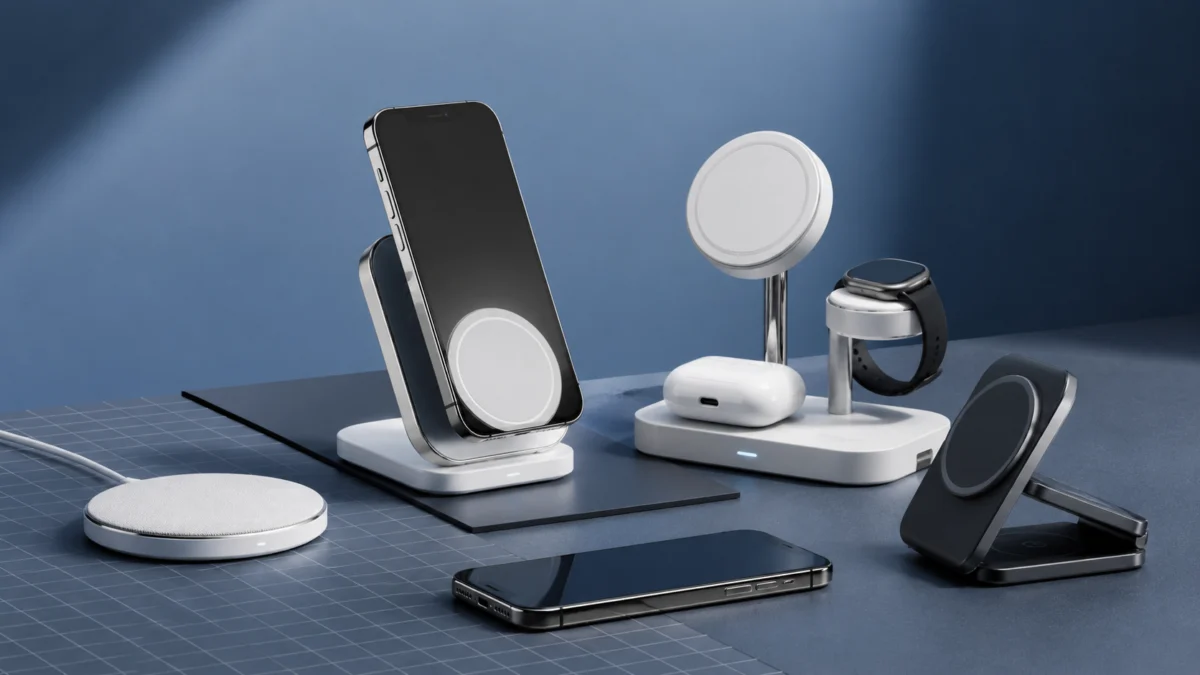
If you’re using an iPhone and an Android phone side by side—or you’re switching to a Qi2-compatible device and want to future-proof your charging setup—you’ve run into the same question: which charger works with both, and which one is actually fast?
The short answer: you need a Qi2-certified charger, not a MagSafe charger. A MagSafe charger will physically snap onto an Android phone equipped with a magnetic case, but it will not execute the wireless handshake required for fast charging. It falls back to a slow 5W trickle instead. We cover the full technical breakdown in the compatibility section below.
In short, Qi2 is about two things: magnetic alignment so the coil lines up every time, and reliable 15W-class wireless charging — up to 25W on Qi2.2 hardware. It matters most if you want snap-on charging across both an iPhone and an Android phone, or if misaligned wireless pads have frustrated you before. If you only ever charge a single iPhone and don’t mind a cable, or your Android lacks native Qi2 support, the upgrade matters less. Below, we break down who actually benefits and which charger fits your phone and budget.
For 2026, the Qi2 market has matured significantly. There are reliable options at every price point, from under $20 flat pads to $230 desktop stations with semiconductor cooling. This guide breaks down the best picks by use case so you can find the right charger without overspending.
Quick List: Our Top Picks at a Glance
- Best Overall for Dual Ecosystem: Baseus Nomos 5-in-1 140W (NH21) — A hybrid station with a 15W Qi2 pad and a 100W retractable USB-C cable, eliminating alignment issues for Android users entirely.
- Best Budget: Anker MagGo Wireless Charger (Pad) — WPC-certified 15W Qi2 for around $25. The safest pick in the sub-$30 market.
- Best Under $50: Belkin UltraCharge Magnetic Charger (WIA014ttBK) — 25W Qi2.2 output with a kickstand for StandBy mode, at $39.99.
- Best Stand Design: Nomad Stand One Max (4th Gen) — Machined from solid metal, weighing 875g, and completely silent. No fan required at 25W.
- Best Multi-Device Station: ESR CryoBoost 3-in-1 (Qi2.2) — 25W for your phone, plus simultaneous Apple Watch and earbuds charging, with the quietest fan cooling in its class.
- Best for Travel: MagBak 3-in-1 Compact Travel Charger — CNC-machined aluminum body, folds flat, and includes a 45W GaN adapter in the box.
- Best Desktop Performance Hub: Anker Prime 3-in-1 Stand (A25X7) — Aerospace-grade Thermoelectric Cooling (TEC) for virtually silent sustained 25W output, plus a real-time Smart Display.
What You Need to Know: Qi2 vs. MagSafe vs. Qi2.2
These three terms are used interchangeably in product listings, and that confusion costs buyers real money. Here is the factual breakdown.
MagSafe is Apple’s proprietary wireless charging standard. It uses a ring of N52 magnets to align the charger with the phone and delivers up to 15W on supported iPhones. Because MagSafe relies on a cryptographic IC handshake that is exclusive to Apple’s hardware, it does not grant fast charging to Android devices. If you place a magnetic-case-equipped Android phone on an Apple MagSafe charger, the magnets will snap together perfectly — but the charger’s internal circuit will fail the handshake and fall back to a 5W to 7.5W Basic Power Profile (BPP) charge, according to Belkin’s official Qi2 compatibility documentation.
Qi2 is the open wireless charging standard developed by the Wireless Power Consortium (WPC) in direct collaboration with Apple. Its Magnetic Power Profile (MPP) uses the same N52 magnet geometry as MagSafe, which is why Qi2 and MagSafe chargers are physically interchangeable. However, Qi2’s IC handshake is not proprietary to Apple. A Qi2-certified charger will negotiate full 15W fast charging with iPhones (12 through 15 series) and with any Android phone that has native Qi2 support built in. This is the key distinction: Qi2 works for both platforms. MagSafe only works at full speed for Apple.
Qi2.2 (marketed as “Qi2 25W”) is the updated specification that raises the wireless ceiling to 25W. A Qi2.2-certified charger delivers 25W to the iPhone 16 running iOS 26 or later, the iPhone 17 series, and natively compatible Android phones like the Google Pixel 10 Pro XL, according to Belkin’s 25W technical guide. All Qi2.2 chargers are backward compatible: they will deliver 15W to older Qi2 phones and a slow charge to basic Qi devices.
| Charger Type | iPhone (12–15) | iPhone (16–17) | Pixel 10 Pro XL | Galaxy S26 Ultra (with Qi2 case) |
|---|---|---|---|---|
| Apple MagSafe | 15W | 15W | 5–7.5W (BPP fallback) | 5–7.5W (BPP fallback) |
| Qi2 Certified (15W) | 15W | 15W | 15W | Up to 15W |
| Qi2.2 Certified (25W) | 15W | 25W | 25W | Up to 25W (case alignment dependent) |
Sources: Belkin official Qi2 compatibility documentation; Belkin 25W wireless charging technical guide.
Which Android Phones Actually Support Qi2 in 2026?
Android’s Qi2 adoption in 2026 is real, but it is not uniform. Understanding your specific phone’s support level prevents expensive mistakes.
Google Pixel 10 Pro XL is the Android benchmark for Qi2 in 2026. It features built-in magnetic arrays and fully supports the Qi2.2 25W standard natively, without requiring any additional accessories, according to Android Central’s coverage of the Pixel 10 lineup.
Google Pixel 10 and Pixel 10 Pro support Qi2, but Google has electronically capped their wireless charging at 15W. Both phones use graphene and vapor chamber cooling to manage thermals within their smaller chassis designs. Android Central reports that the 25W ceiling is exclusively reserved for the Pro XL’s larger thermal envelope.
Samsung Galaxy S26 Ultra has the internal hardware to receive a 25W wireless charge, but it does not have magnetic alignment rings built into the chassis. To use any Qi2 or Qi2.2 charger, you must pair the phone with a Qi2-certified magnetic case. According to Belkin’s 25W guide, if that case’s magnetic ring is misaligned by even a millimeter relative to the internal induction coil, the charger detects poor magnetic flux linkage and throttles power down to a safe 10W–12W limit rather than risk a fire hazard. Multiple users in the Reddit r/MagSafe community corroborate this, reporting that the S26 Ultra frequently drops from 25W to 12W due to case misalignment — with the only reliable workaround being to remove the case and charge bare.
For a deeper look at how the Galaxy S26 Ultra handles battery health and charging in general, see our guide: Galaxy S26 Ultra Battery & Charging Guide.
If you own an S26 Ultra and are considering Qi2, the honest recommendation is to use a charger with a wired USB-C fallback option — such as the Baseus Nomos 5-in-1 reviewed below — to guarantee speed regardless of case alignment.
What to Look For Before You Buy
WPC Certification, Not “Compatible” Marketing Language
The single most important filter is official WPC certification. E-commerce platforms in 2026 are saturated with chargers marketed as “Qi2 Compatible” or “MagSafe Compatible” that use N52 magnets but lack the certified IC chip required to perform the MPP handshake. These products physically snap onto your phone but charge at 5W to 7.5W — the same speed as a charger from five years ago. Verify the official “Qi2” or “Qi2 25W” logo on the packaging, or check the WPC’s public certification database before purchasing.
Qi2 vs. Qi2.2 — Match the Spec to Your Phone
If your phone is an iPhone 12 through 15, or a Pixel 10 / 10 Pro, a standard Qi2 (15W) charger is all you need and is significantly less expensive. Upgrading to a Qi2.2 (25W) charger only delivers a speed benefit on the iPhone 16 running iOS 26 or later, the iPhone 17 series, and the Pixel 10 Pro XL. And as 9to5Google’s analysis of Pixel 10 Pro XL charging data shows, the 25W peak is typically only sustained for a few minutes before the phone thermally throttles down to 15W to protect battery chemistry. Over a full 0–100% charge cycle, the real-world time difference between a well-engineered 15W and a 25W charger is often smaller than the specifications suggest.
Adapter Requirements
Achieving 25W wireless output requires a high-quality USB-C Power Delivery (PD) adapter rated at 40W to 65W that supports Programmable Power Supply (PPS) protocols. Many premium chargers — including the Nomad Stand One Max — ship without an adapter. Plugging a 25W wireless station into a legacy 20W Apple adapter or an older QuickCharge 3.0 brick causes the station to fail power negotiation and throttle output severely. Always confirm what is in the box before purchasing, and budget for a GaN adapter separately if needed.
Cooling System: Passive vs. Active
Higher wattage generates more heat. Chargers address this in one of three ways: passive cooling (relies on the metal chassis as a heat sink), active fan cooling (mechanical fans push air over the coils), or Thermoelectric Cooling (TEC, a semiconductor-based system that actively draws heat away from the surface). Fan-cooled chargers can generate audible coil whine and fan noise, which matters significantly for nightstand placement. The noise profiles of specific products are covered in each review below.
Case Thickness
Electromagnetic induction drops exponentially with distance. A heavy-duty or leather wallet case exceeding 3mm in total thickness causes Qi2 chargers to detect a “foreign object” and abort the charge or reduce it to a trickle, according to Satechi’s product documentation and Smartish’s 2026 Android charging guide. If you use a thick case, factor this into your charger selection.
Best Overall for Dual Ecosystem: Baseus Nomos 5-in-1 140W (NH21)
For anyone operating both an iPhone and an Android phone — especially a Samsung Galaxy S26 Ultra — the Baseus Nomos 5-in-1 is the most practical pick on this list. It solves the core problem of Android Qi2 alignment by giving you a reliable fallback that requires zero alignment at all.
The NH21 integrates a 15W Qi2-certified magnetic pad on its top surface alongside a retractable, heavy-duty USB-C cable capable of 100W wired output. This means you can place your iPhone on the Qi2 pad for effortless magnetic wireless charging while simultaneously delivering unthrottled wired power directly to your Android device — no case alignment, no flux linkage gamble, no throttling. It also features two additional USB-C ports (supporting up to 140W total output) and a USB-A port, allowing you to simultaneously fast-charge a laptop or tablet. According to PCMag’s 2026 wireless charger roundup, Wirecutter specifically highlights the Nomos for its innovative approach to reducing desktop clutter.
The price point — around $88 — makes this extraordinary value for the hardware on offer. A built-in AC adapter means there is no separate power brick to source.
✅ Buy if:
- You use an iPhone and an Android phone (especially a Galaxy S26 Ultra) side by side and want one charger that handles both reliably.
- You want to charge a laptop, tablet, and phone from a single desktop hub.
- You are frustrated by Android magnetic case alignment issues and want a wired fallback built into your charging station.
❌ Don’t buy if:
- You only charge one device at a time and don’t need a multi-port hub.
- You need a travel-ready solution that folds flat and fits in a carry-on.
Best Budget Qi2 Charger: Anker MagGo Wireless Charger (Pad)
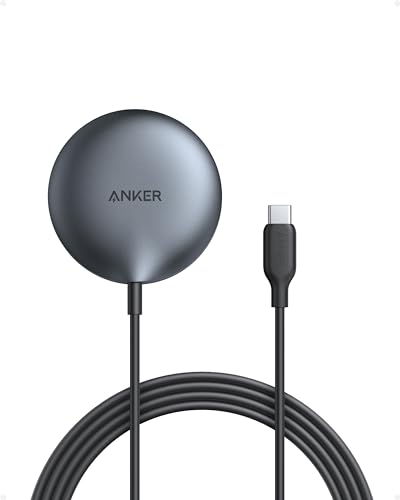
The single greatest risk in the sub-$30 wireless charger market is accidentally buying a counterfeit. At around $25, the Anker MagGo Pad is the safest certified entry point.
According to Anker’s official product documentation, this charger delivers WPC-certified 15W Qi2 charging to both the iPhone 12–17 series and compatible Android devices. Its simple circular puck design uses passive ambient cooling, which eliminates any mechanical fan noise. There are no multi-device features, no Apple Watch cradle, and no kickstand. What it does — charge a single phone at Qi2 speeds — it does reliably. PCMag’s 2026 roundup lists it as the definitive budget-segment recommendation for exactly this reason.
Note that this charger does not ship with an adapter. You need a USB-C PD adapter of at least 18W to achieve full 15W output.
Please check the Amazon product page for the latest price and availability.
✅ Buy if:
- You want the cheapest genuinely WPC-certified Qi2 charger available and already own a compatible USB-C PD adapter.
- You are buying your first Qi2 charger and want to try the standard before investing in a premium model.
❌ Don’t buy if:
- Your phone supports Qi2.2 25W and you want to use that speed (step up to the Belkin WIA014ttBK below).
- You need to charge a smartwatch or earbuds at the same time.
Best Qi2 Charger Under $50: Belkin UltraCharge Magnetic Charger (WIA014ttBK)
At $39.99, the Belkin UltraCharge Magnetic Charger is the most affordable way to access Qi2.2 25W speeds. It targets users whose phones — iPhone 16 running iOS 26 or later, iPhone 17, or Pixel 10 Pro XL — can actually take advantage of the higher wattage.
Beyond raw speed, this charger includes a deployable kickstand. This allows you to prop the phone upright in landscape or portrait orientation, which is useful for video calls, media consumption, or Apple’s iOS StandBy display mode. It is a single-device charger in a portable form factor that bridges the gap between a basic flat pad and a full desktop stand, according to PCMag’s 2026 review. Belkin does not include an adapter; a USB-C PD adapter of at least 30W is recommended to reliably achieve 25W output.
One important note on Belkin’s broader charger lineup: some older BoostCharge pad models lack MPP magnetic alignment. The WIA014ttBK, by contrast, is a Qi2.2-certified device with full MPP. Verify the model number before purchasing.

Please check the Amazon product page for the latest price and availability.
✅ Buy if:
- You own an iPhone 16 (iOS 26+), iPhone 17, or Pixel 10 Pro XL and want 25W at a budget-friendly price.
- You use iOS StandBy or Android’s desk mode and want a kickstand without buying a full stand.
❌ Don’t buy if:
- You need simultaneous charging for a smartwatch or earbuds.
- Your phone’s Qi2 ceiling is 15W — the Anker MagGo Pad saves you $15 with identical real-world performance.
Best Stand Design: Nomad Stand One Max (4th Gen)
If desk aesthetics, acoustic silence, and physical stability are your priorities, no other charger on this list comes close to the Nomad Stand One Max (4th Gen).
According to Nomad’s official product page, this stand is machined from a solid block of metal — available in Silver or Carbide — and weighs 875 grams (nearly two pounds). That weight is not incidental. It gives the stand two crucial advantages. First, the massive metal chassis functions as a highly efficient passive heat sink, allowing the Stand One Max to sustain Qi2.2 25W charging speeds without a single mechanical fan. This makes it completely silent under load — a meaningful difference for users who place their charger on a nightstand. Second, the immense mass keeps the stand anchored to the desk when you pull a strongly magnetized phone off with one hand.
The Stand One Max also supports an Apple Watch fast charger module and a 5W earbud dish, making it a 3-in-1 station. According to MacRumors’ coverage, the Apple Watch module is MFW-certified for rapid charging of current Apple Watch models. The cable measures 2.0m.
Two important caveats: at $159, this is a premium purchase. And Nomad ships it without an AC adapter, citing sustainability. You need to pair it with a high-quality 40W to 65W GaN adapter to achieve 25W output — budget for that separately.
✅ Buy if:
- Acoustic silence is a hard requirement — you use the charger on a nightstand or in a quiet office environment.
- You want a premium desk object, not just a charger, and you own an Apple Watch and AirPods alongside your phone.
- You already own a capable 40W+ GaN USB-C adapter.
❌ Don’t buy if:
- You need to travel with your charger — at 875 grams, this stand is a permanent desk fixture.
- You use an Android phone as your primary device; the Apple Watch cradle adds cost you won’t use.
Best Multi-Device Station: ESR CryoBoost 3-in-1 (Qi2.2, 25W)
The ESR CryoBoost 3-in-1 is the most balanced 25W multi-device station on this list relative to its price. It sits in the $100–$130 range and delivers simultaneous charging to a phone (25W), an Apple Watch, and wireless earbuds.
The critical differentiator is ESR’s proprietary CryoBoost active cooling fan. Sustaining 25W inductive output generates significant heat, and chargers without adequate thermal management throttle power back quickly to protect the phone’s battery. ESR’s fan operates dynamically — spinning up under load and slowing down during lighter sessions. Crucially, according to community evaluations on Reddit r/MagSafe, ESR’s fan runs significantly quieter than direct competitors like the Belkin UltraCharge Pro 25W under equivalent load conditions. The Belkin model, by contrast, receives consistent reports of high-frequency coil whine and fan noise that makes it unsuitable for nightstand use.
The ESR CryoBoost also folds flat, adding unexpected travel utility to what is otherwise a desktop-class charging station. An adapter is included in the box.
✅ Buy if:
- You want to charge your phone, Apple Watch, and earbuds simultaneously from a single station at 25W.
- You need active cooling for 25W performance but can’t justify the $230 price tag of the Anker Prime TEC stand.
- You occasionally travel and want a multi-device station that folds flat.
❌ Don’t buy if:
- Absolute acoustic silence is required — the fan is quieter than Belkin’s, but it is still audible under peak 25W load.
- Your phone only supports 15W Qi2; the Satechi 2-in-1 (see Also Considered below) achieves the same multi-device result at a lower price.
Best for Travel: MagBak 3-in-1 Qi2.2 Compact Travel Charger
The MagBak 3-in-1 Compact Travel Charger is the top travel pick at $129 because it solves travel charging’s two biggest problems simultaneously: bulk and adapter incompatibility.
According to MagBak’s official product documentation, the chassis is CNC-machined from a Space Gray aluminum unibody. Like the Nomad Stand One Max, this aluminum body functions as a passive heat sink, allowing the charger to support Qi2.2 25W speeds without a mechanical fan — completely silent operation. The device folds completely flat for transport, minimizing its footprint in a carry-on or laptop bag. It charges a phone (25W), an Apple Watch, and earbuds simultaneously.
What elevates the MagBak above other travel options is its included accessories. It ships with a 45W USB-C GaN adapter and a 1.5m cable. This is significant because many competing 25W chargers ship without adapters, forcing travelers to source a separate GaN brick. The MagBak arrives as a complete, ready-to-use system.
✅ Buy if:
- You travel frequently and want a 25W Qi2.2 3-in-1 charger that folds flat and includes an adapter in the box.
- You need silent operation in hotel rooms at night and can’t accept fan noise from active-cooled alternatives.
❌ Don’t buy if:
- You primarily charge at a fixed desk — the ESR CryoBoost or Anker Prime A25N1 offer better active thermal management for sustained desktop use.
- You use an Android phone exclusively — the Apple Watch cradle adds cost you won’t use.
Best Desktop Performance Hub: Anker Prime 3-in-1 Stand (A25X7)
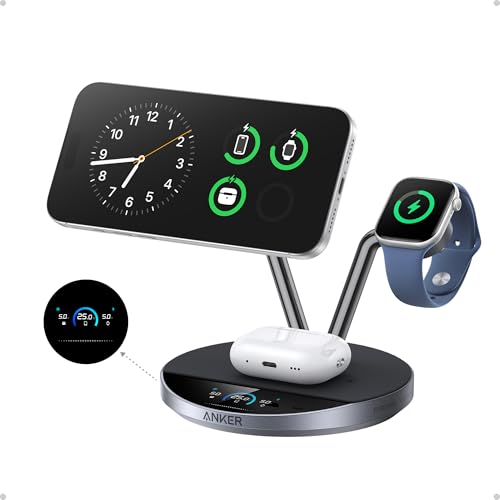
At $229.99, the Anker Prime 3-in-1 Stand (A25X7) is the most technically advanced wireless charger on this list. It is built for users who want the absolute best thermal management money can buy, and for whom a $230 charger is a rational purchase.
The A25X7 abandons mechanical air-cooling fans entirely in favor of Thermoelectric Cooling (TEC), a semiconductor-based system that actively draws heat away from the charging coil surface rather than simply pushing ambient air over it, according to Anker’s official product documentation. This produces two measurable outcomes: sustained 25W output over longer periods before thermal throttling occurs, and virtually silent operation. Community evaluations on Reddit r/MagSafe consistently award the A25X7 the highest acoustic marks of any active-cooled 25W charger currently available.
The stand also features a Smart Interactive Display that shows real-time power flow and thermal telemetry — a feature aimed squarely at enthusiasts who want visibility into their charging session. A 65W adapter ships in the box. Anker’s official page confirms the A25X7 was released in Q1 2026 and is available via Amazon US and Anker Direct.
Please check the Amazon product page for the latest price and availability.
✅ Buy if:
- You charge at 25W daily and want sustained peak output without thermal throttling or fan noise.
- You are a tech enthusiast who values real-time power telemetry and best-in-class engineering over price.
- You charge a phone, Apple Watch, and earbuds simultaneously and want the quietest possible 25W multi-device station.
❌ Don’t buy if:
- Your phone maxes out at 15W Qi2 — you are paying a $200 premium for a speed advantage you cannot access.
- You need portability — this is a fixed desktop station.
Also Considered
Satechi 2-in-1 Foldable Qi2 Wireless Charging Stand (ST-Q21FM)
At $79.99, the Satechi 2-in-1 is the premium option for users who want a beautifully engineered stand for a single phone and earbuds at 15W Qi2. Its aluminum enclosure, vegan leather base, and heavy-duty friction hinges give it a distinctly professional desk presence. It folds completely flat for occasional travel. The secondary 5W pad in the base charges earbuds but does not support Apple Watch. No adapter is included; Satechi requires at least 30W input. A solid choice if you don’t need Apple Watch charging and don’t yet have a Qi2.2-capable phone.

Please check the Amazon product page for the latest price and availability.
Anker Prime Foldable 3-in-1 (A25N1)
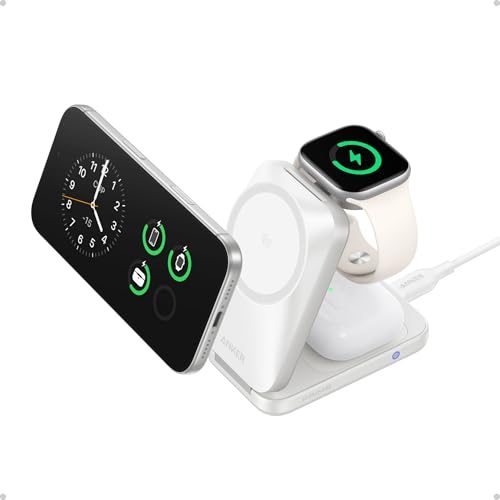
The foldable counterpart to the A25X7 TEC stand, this $149.99 model collapses to approximately the size of a deck of cards and weighs just 6.9 oz. It supports 25W Qi2.2, an MFW-certified Apple Watch fast charger module, and earbuds. Anker’s AirCool active fan manages thermals effectively. It ships with a 45W USB-C adapter and 5-foot cable. The primary reason it does not earn the “Best Travel” title over the MagBak is fan noise: the MagBak’s passive aluminum cooling is completely silent, while the A25N1’s fan is audible under 25W load, according to 9to5Toys’ hands-on coverage from February 2026.
Please check the Amazon product page for the latest price and availability.
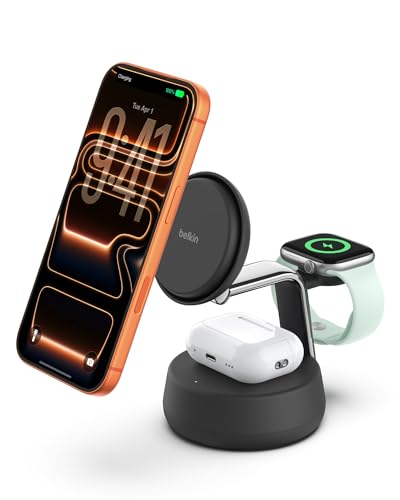
Belkin UltraCharge Pro 3-in-1 (WIZ040ttCH)
Priced at $129.99, the Belkin UltraCharge Pro offers Qi2.2 25W and multi-device charging (phone, Apple Watch, earbuds) with a ChillBoost active cooling array. It pushes a phone from 0 to 50% in approximately 25 to 29 minutes, according to Belkin’s official specification data. However, it is the primary charger in this category flagged for acoustic issues: Reddit r/MagSafe community reports consistently describe high-frequency coil whine and fan noise under 25W load, making it unsuitable for bedroom or quiet-office use. If fan noise is not a concern for your placement, it is a capable device at a competitive price. If noise matters, choose the ESR CryoBoost instead.
Please check the Amazon product page for the latest price and availability.
Purchasing Pitfalls: What to Watch Out For
The “Qi2 Compatible” Deception
The most pervasive risk in the 2026 market involves non-certified chargers marketed with language like “Qi2 Compatible,” “MagSafe Compatible,” or “Magnetic Fast Charge.” These products use standard N52 magnets — so they snap onto your phone perfectly — but lack the WPC-certified IC chip that executes the MPP power handshake. They default to 5W to 7.5W charging while generating excess heat. According to the WPC’s official Qi standard documentation, the only reliable way to verify certification is to look for the official “Qi2” or “Qi2 25W” logo on the packaging, or to search the WPC’s public certification database directly.
The “Adapter Not Included” Power Trap
Several premium chargers — most notably the Nomad Stand One Max and the Satechi 2-in-1 — ship without an AC adapter. Powering a 25W wireless station with a legacy 20W Apple adapter or an older QuickCharge 3.0 brick causes the station to fail the USB-C Power Delivery handshake and throttle output severely. Budget for a 40W to 65W GaN USB-C PD adapter separately if your chosen charger does not include one.
Case Thickness Interference
Electromagnetic induction drops exponentially with distance. A heavy-duty, ruggedized, or leather wallet case exceeding 3mm in total thickness can cause the Qi2 charger to interpret the material as a foreign object and abort the charge or reduce it to a trickle, according to Satechi’s product documentation. If you use a thick case, either remove it during charging or select a charger with a wired USB-C fallback, such as the Baseus Nomos 5-in-1.
The Belkin Connected Equipment Warranty
One often-overlooked purchasing factor is financial protection against hardware failure. Belkin includes a Connected Equipment Warranty (CEW) with its certified chargers: if an electrical fault in the Belkin charger damages your connected smartphone or smartwatch, Belkin provides financial recourse up to $2,500 in repair or replacement costs, according to Belkin’s official warranty documentation. Unbranded or uncertified chargers from overseas vendors carry no equivalent protection.
Frequently Asked Questions
Is Qi2 the same as MagSafe?
No. Qi2 and MagSafe share the same N52 magnet geometry, so their chargers physically snap on interchangeably. The difference is the handshake: MagSafe’s is proprietary to Apple, while Qi2’s is open. A Qi2-certified charger negotiates full 15W with both iPhones and supported Android phones, whereas a MagSafe charger drops a magnetic-case Android to a 5–7.5W trickle.
Does Qi2 work with Android phones?
Yes, but support isn’t uniform and depends on the model. The Pixel 10 Pro XL supports Qi2.2 25W natively, while the Pixel 10 and 10 Pro are capped at 15W. The Galaxy S26 Ultra has no built-in magnetic rings, so it needs a Qi2-certified magnetic case — and if that case is misaligned, the charge can throttle down to roughly 10–12W. Check your specific phone’s Qi2 support before buying.
Is a Qi2 charger worth buying in 2026?
It’s worth it if you want consistent magnetic alignment and reliable 15W-class wireless charging. Match the spec to your phone: a 15W Qi2 charger is enough for iPhone 12–15 and the Pixel 10 / 10 Pro, while Qi2.2 25W only adds speed on the iPhone 16 (iOS 26 or later), iPhone 17, and Pixel 10 Pro XL. Whichever you pick, verify WPC certification rather than trusting “Qi2 compatible” marketing.
Why is my Qi2 charger not charging at 15W?
Common causes are: an uncertified “Qi2 compatible” charger that lacks the WPC IC chip and defaults to 5–7.5W; a case thicker than about 3mm that the charger reads as a foreign object; an underpowered adapter (you need at least an 18W USB-C PD adapter for full 15W); or, on Android, a magnetic case that is misaligned with the internal coil.
How We Researched
This guide is built on a structured review of manufacturer official specifications and technical documentation (Anker, Belkin, ESR, Nomad, Satechi, MagBak, Baseus, and the Wireless Power Consortium), independent editorial benchmarks from PCMag’s 2026 wireless charger roundup and 9to5Google’s Pixel 10 Pro XL Qi2 performance analysis, and direct community evaluation threads on Reddit r/MagSafe, r/GooglePixel, and r/Android covering real-world coil alignment, fan noise, and thermal throttling behavior. All product specifications, price data, and compatibility claims cited in this article are attributed to their primary sources. We did not conduct hands-on device testing.
Final Recommendations
The right Qi2 charger in 2026 depends entirely on your device lineup and where the charger lives.
If you use both an iPhone and an Android phone — especially a Galaxy S26 Ultra — the Baseus Nomos 5-in-1 is the most practical choice. Its hybrid Qi2 pad plus 100W wired USB-C cable means Android alignment issues never strand you at 12W. It also doubles as a full desktop charging hub for laptops and tablets.
If you want the lowest cost of entry into genuine, certified Qi2 charging, the Anker MagGo Pad at around $25 is the safest purchase in a budget market full of uncertified counterfeits.
If your phone supports Qi2.2 25W and you want that speed without a full stand, the Belkin UltraCharge Magnetic WIA014ttBK at $39.99 with its built-in kickstand is the most efficient upgrade path.
For a permanent desk fixture that is completely silent and beautifully engineered, the Nomad Stand One Max has no rival. For the best balance of 25W performance, multi-device support, and quiet cooling at a justifiable price, the ESR CryoBoost 3-in-1 is the pick. For travel, the MagBak 3-in-1 is the only charger that combines passive silence, 25W Qi2.2 output, and an included GaN adapter. And for users who want the most advanced thermal engineering available regardless of cost, the Anker Prime A25X7 with its TEC semiconductor cooling sets the current ceiling.
Whatever you choose, verify the WPC Qi2 certification before purchasing. Everything else in this market is just magnets.

Comments