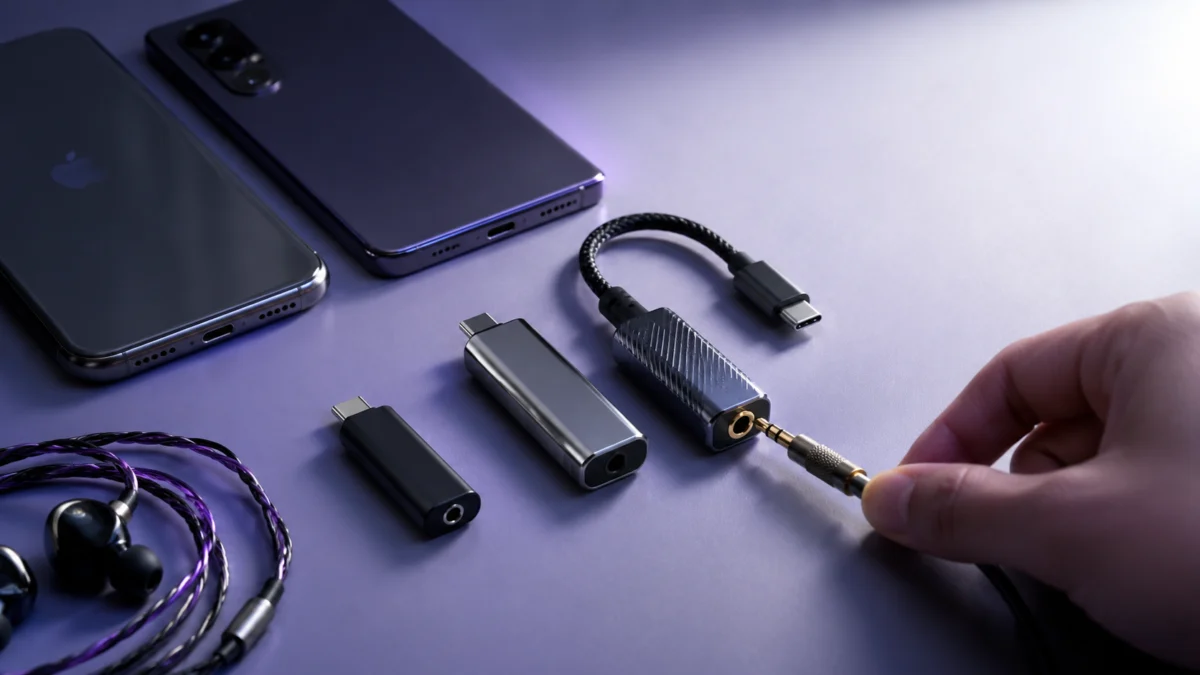
The short version: for most people pairing standard wired earphones with a USB-C iPhone or Android phone, the inexpensive Apple USB-C to 3.5mm adapter is enough — it measures well, draws very little power, and supports inline mics for calls. You only need a dedicated DAC dongle if you run harder-to-drive headphones, want on-device EQ, or care about 4.4mm balanced output. The right pick depends almost entirely on your use case, not on a single “best sounding” ranking.
Affiliate disclosure: Fixory may earn a commission from qualifying purchases made through links in this article, at no extra cost to you. This does not influence which products we cover or how we describe them.
Jump to a section:
- Quick Picks
- Do you need a DAC dongle, or is a basic adapter enough?
- DAC dongle vs portable DAC/amp
- Best USB-C DAC dongles by use case
- 3.5mm vs 4.4mm balanced
- iPhone vs Android compatibility
- Buying checklist
- FAQ
Quick Picks: Which USB-C DAC Dongle Should You Buy?
Most listeners are well served by the inexpensive Apple USB-C adapter for standard earphones and calls. Step up to a dedicated dongle only for harder-to-drive headphones, on-device tuning, or 4.4mm balanced output. The choice tracks your headphones and platform, not a universal sound ranking.
| Use case | Recommended pick | Why |
|---|---|---|
| Standard earphones + mic for calls | Apple USB-C Adapter / UGREEN 2-in-1 | Low noise, CTIA mic support, minimal battery drain |
| Simple upgrade for sensitive IEMs | AudioQuest DragonFly Copper / FiiO KA11 | Plug-and-play, lower power draw, no app required |
| Hard-to-drive headphones or on-device PEQ | iBasso DC07 Pro / FiiO KA15 | 4.4mm balanced output, high power, on-device controls |
| Battery-powered, desk-grade driving power | iFi iDSD GR 2 | Internal battery, very high output, Bluetooth input |
Do You Need a DAC Dongle, or Is a Basic USB-C Adapter Enough?
For standard wired earphones and phone calls, a basic adapter is enough. The US Apple USB-C adapter outputs around 1Vrms, has a low noise floor, and supports inline mics and remotes. Move to a dedicated DAC dongle only for high-impedance or low-sensitivity headphones, hiss-sensitive IEMs, or when you want on-device EQ and filters.
The most common mistake is overbuying. According to widely repeated community discussions, many people pair a costly balanced dongle with sensitive in-ear monitors that the cheap adapter already drives cleanly, then notice little or no improvement. A dedicated DAC earns its place when one of these is true:
- Your headphones are hard to drive (higher impedance or low sensitivity) and sound quiet or flat on a basic adapter.
- You want parametric EQ, digital filters, or gain control that a simple adapter cannot provide.
- You specifically need a 4.4mm balanced connection for more output power or channel separation.
- You hear background hiss on very sensitive IEMs and want a lower noise floor.
If none of those apply, the inexpensive adapter is the rational choice — and it is one of the few options that reliably handles a headset microphone.
USB-C DAC Dongle vs Portable DAC/Amp: The Key Difference
A DAC dongle is small and bus-powered, drawing energy from your phone, while a portable DAC/amp has its own battery and far higher output. Simple adapters do basic conversion; dongles add more power and features; portable amps drive demanding headphones without taxing your phone; Bluetooth-capable amps add wireless input. These four categories are easy to confuse, so the table below separates them.
| Category | Power source | Typical output | Effect on phone battery | Wireless input |
|---|---|---|---|---|
| Simple USB-C headphone adapter | Bus-powered | Low (entry level) | Minimal | No |
| USB-C DAC dongle | Bus-powered | Low to high | Moderate to heavy | No |
| Battery-powered portable DAC/amp | Internal battery | High to very high | Low (hybrid power modes possible) | Sometimes |
| Bluetooth-capable DAC/amp | Internal battery | High | Low | Yes |
The practical takeaway: a bus-powered dongle is the most pocketable option but spends your phone’s battery, especially in high-power modes. A battery-powered portable DAC/amp is larger but can drive demanding headphones without draining the phone, and some models manage power intelligently between an external source and the internal battery.
Best USB-C DAC Dongles by Use Case
The best dongle is the one that fits your headphones, platform, and priorities. Below, picks are grouped by use case rather than ranked by sound, because the right answer changes completely depending on whether you need mic support, low battery drain, on-device tuning, or raw driving power. Each entry includes a quick buy/skip guide.
Best cheap USB-C headphone adapter: Apple USB-C to 3.5mm Adapter
The Apple USB-C adapter is the value benchmark. It uses a Texas Instruments DAC with a low 2.3Ω output impedance and very low power draw, and it fully supports inline mics and remotes. It plays Apple Music Lossless up to 24-bit/48kHz but does not support Hi-Res Lossless sample rates, and the US version outputs more than the EU version.
Buy if: you use standard earphones or efficient IEMs, need mic support for calls, and want the lowest possible cost and battery drain.
Don’t buy if: you have hard-to-drive headphones or want Hi-Res sample-rate playback or on-device EQ.
Check Apple adapter on Amazon
/
Apple official site
/
Apple Support: lossless audio
Best UGREEN-style adapter with charging: UGREEN 2-in-1 USB-C to 3.5mm
The UGREEN 2-in-1 adds a USB-C passthrough so you can charge while listening, which the Apple adapter cannot do. It supports CTIA mics and handles standard earphones well. Some users report case interference or warmth in certain setups, so check fit with your phone case before buying.
Buy if: you want to charge and listen at the same time and need mic support.
Don’t buy if: you prioritize the lowest noise floor or driving power for demanding headphones.

Please check the Amazon product page for the latest price and availability.
Best simple DAC dongle for iPhone: AudioQuest DragonFly Copper or FiiO KA11
For iPhone users who want a no-app, plug-and-play upgrade, the DragonFly Copper and FiiO KA11 are strong choices. According to AudioQuest, the Copper’s newer processor reduces power consumption versus the prior generation, which matters on a bus-powered iPhone. The KA11 is very light at 8.5g while still offering more output than a basic adapter.
Buy if: you’re on iPhone, want a simple sound upgrade for IEMs, and prefer no companion app.
Don’t buy if: you need a microphone, 4.4mm balanced output, or the absolute lowest battery drain.
Note: the DragonFly Copper uses a USB-A connector, so it needs a USB-C adapter to connect to a modern phone. Confirm you have the right adapter before buying.
DragonFly Copper official site
Check FiiO KA11 on Amazon
/
FiiO KA11 official site
Best Android-friendly DAC dongle: Moondrop FreeDSP Pro or FiiO KA15
Android users get the most from companion apps, which are frequently Android-only. The Moondrop FreeDSP Pro is a cable-integrated DSP that lets you load community PEQ profiles, and the FiiO KA15 supports app-based 10-band PEQ. Both reward Android owners who want deep, software-driven tuning.
Buy if: you’re on Android and want PEQ, filters, and detailed tuning control.
Don’t buy if: you’re on iPhone and expect full app functionality, or you want minimal battery drain.
Check Moondrop FreeDSP Pro on Amazon
/
Moondrop official site
Check FiiO KA15 on Amazon
/
FiiO KA15 official specs
Best 4.4mm balanced dongle: iBasso DC07 Pro
The iBasso DC07 Pro pairs a quad-DAC layout with notably high efficiency, and iBasso reports a high-efficiency DC-DC converter that keeps current draw low while still delivering substantial balanced output. Crucially for iPhone users, its OLED display and physical knob let you change gain and filters on the device itself, with no app required.
Buy if: you want strong 4.4mm balanced output, low noise, and on-device controls that work the same on iOS and Android.
Don’t buy if: you only use efficient earphones and a basic adapter already sounds clean to you.
Best for sensitive IEMs: Questyle M15i
For very sensitive multi-driver IEMs, the biggest annoyance is audible hiss during quiet passages. Questyle’s M15i uses its current-mode amplification design to push the noise floor very low, aiming for a black background with hiss-prone earphones. It is a premium-tier option focused on clean amplification rather than software features.
Buy if: you use sensitive IEMs and want the cleanest possible background.
Don’t buy if: you need a microphone or app-based EQ, or you’re on a tight budget.

Please check the Amazon product page for the latest price and availability.
Best for harder-to-drive headphones: FiiO KA15 or FiiO KA13
For demanding headphones, the FiiO KA15 and KA13 stand out because their Desktop Mode delivers roughly 550–560mW into 32Ω over balanced — far above typical dongle output. That extra headroom helps with harder-to-drive full-size headphones. The trade-off is significant: Desktop Mode raises power draw, heat, and phone battery consumption.
Buy if: you drive demanding headphones from a phone and want desk-grade power in a dongle.
Don’t buy if: battery life is your top priority, or you only use efficient IEMs.
One caution: high output does not mean any headphone will be fully driven. Extremely low-sensitivity planar headphones may still want a dedicated desktop amp.
Check FiiO KA13 on Amazon
/
FiiO KA13 official site
Best battery-powered portable DAC/amp: iFi iDSD GR 2
When you need serious driving power without draining your phone, the iFi iDSD GR 2 is the standout. It carries a large internal battery and offers very high balanced output, and iFi describes a hybrid power mode that switches intelligently between external power and the battery. It also adds Bluetooth input with high-quality codecs, making it the most flexible — and a premium-tier — option here.
Buy if: you want desk-class power, wireless input, and minimal impact on phone battery, and don’t mind the size and price.
Don’t buy if: you want something pocketable that clips onto a phone, or you only use efficient earphones.
Two more options worth knowing: the ddHiFi TC44Pro E3 is a very small dual-DAC dongle with a physical gain button, and the iFi GO link 2 is an ultralight 3.5mm dongle with crosstalk-reduction technology. Both suit minimalists who don’t need 4.4mm balanced or app control.
ddHiFi official site
/
Check iFi GO link 2 on Amazon
/
iFi GO link 2 official site
3.5mm vs 4.4mm Balanced: What Actually Matters on a Phone
A 4.4mm balanced connection mainly increases output voltage swing for more driving power and separates left and right channels to reduce crosstalk. It clearly helps harder-to-drive headphones. On efficient, sensitive IEMs, the audible benefit is often small, and higher gain can make hiss more noticeable. One firm limitation: 4.4mm is output-only, so it cannot carry a microphone.
| Factor | 3.5mm single-ended | 4.4mm balanced |
|---|---|---|
| Main benefit | Simplicity, universal compatibility | More output power, lower crosstalk |
| Microphone support | Possible (CTIA TRRS) | Not possible (output-only) |
| Best for | IEMs, calls, everyday use | Harder-to-drive headphones |
| Risk on sensitive IEMs | Low | Possible added hiss at high gain |
In short, balanced is a tool for power and channel separation, not a guaranteed sound upgrade. If your earphones already play loud and clean from a basic adapter, balanced may not change much.
iPhone vs Android Compatibility: Apps, Power Draw, Mic Support, and Volume
Compatibility differs in four practical ways. Companion apps are often Android-only, so iPhone users may lose EQ and filter control unless the device has on-board controls. iPhone Bluetooth supports only AAC and SBC, not LDAC or aptX Lossless. Microphones work reliably on simple adapters but not over 4.4mm balanced. And older Android volume limits were addressed in Android 16.
App support
Many tuning apps such as FiiO Control and Moondrop Link are developed for Android. According to manufacturer materials, some brands address this with web-based tuning or full on-device controls. If you’re on iPhone and want PEQ, prioritize a dongle that offers on-device or web-based configuration.
Bluetooth codecs
If you’re considering a Bluetooth-capable DAC/amp, note that iPhone supports only AAC and SBC, while many Android phones support LDAC, aptX Lossless, and LHDC. A premium wireless DAC will not unlock those higher-bitrate codecs on an iPhone, so weigh that before paying for wireless features you can’t use on iOS.
Microphone support
Simple adapters from Apple and brands like UGREEN support CTIA TRRS microphones and inline remotes. Many audiophile DACs omit the microphone ADC circuit to focus on output quality, and 4.4mm balanced cannot carry a mic at all. The FiiO KA15 is a noted exception, supporting inline control and mic on its 3.5mm port.
Android volume behavior
Older Android versions limited maximum volume over USB audio because the OS did not properly control hardware volume, so users often relied on apps like USB Audio Player PRO to bypass the mixer. According to multiple community reports, Android 16 fixed this routing issue, so default volume now behaves correctly. On older, un-updated Android phones, a bypass app may still be needed.
Buying Checklist: Output, Noise, Heat, Battery, Controls, and Cable Strain
Before buying, run through seven practical checks. These cover the gap between marketing specs and daily use: how much power you actually need, whether background noise will bother sensitive IEMs, how much heat and battery drain you’ll accept, how you’ll control settings, and how durable the cable is. Matching these to your habits prevents most regret purchases.
- Output power for your headphones. Efficient IEMs need little; harder-to-drive headphones benefit from high-output or Desktop Mode models.
- Background noise. Very sensitive IEMs reveal hiss, so a low noise floor matters more than raw power.
- Heat and battery drain. High-power dongle modes run warm and consume phone battery quickly, per multiple user reports.
- Battery strategy. If long sessions matter, consider a battery-powered portable DAC/amp instead of a bus-powered dongle.
- Controls. Decide whether you need on-device controls (better for iPhone) or are fine with an Android-only app.
- Microphone. If you take calls, choose a simple adapter or a dongle that explicitly supports a 3.5mm mic.
- Cable durability and UAC mode. Fixed cables and heavy housings strain the port over time; gamers should also check for a UAC 1.0 mode for consoles.
On that last point: modern phones use UAC 2.0, but consoles such as the Nintendo Switch and PS5, and some older PCs, may only recognize UAC 1.0. A few dongles can force a UAC 1.0 fallback, which matters if you want one dongle for both phone and console use.
How We Researched
This article is based on manufacturer documentation, official support materials, and community reports where available. We have not conducted hands-on lab testing. Any performance figures or compatibility claims are attributed to official sources or clearly identified community reports. Our sources include manufacturer specification pages for FiiO, iBasso, iFi, AudioQuest, Questyle, Moondrop, ddHiFi, and Apple; Apple support documentation on lossless audio; and recurring user reports across audio communities and hardware forums regarding volume behavior, battery drain, and connection durability. Supporting setup and interface videos were reviewed to confirm on-device controls and indicator behavior, but no video was used as a measured performance claim.
FAQ: USB-C DAC Dongles for iPhone and Android
Is there a difference between the US and EU Apple USB-C adapter?
Yes. The US version outputs around 1Vrms, while the EU version is limited to roughly 0.5Vrms to comply with European hearing-protection rules. If you bought the adapter in Europe and find it quiet with demanding headphones, the regional power limit is the likely reason.
Was the old Android volume problem with the Apple dongle fixed?
According to multiple community reports, Android 16 fixed the USB audio routing bug that capped volume, so default output now works correctly. On older Android phones that haven’t been updated, you may still need an app like USB Audio Player PRO to reach full volume.
Can I use aptX Lossless or LDAC with an iPhone?
No. iPhone supports only the AAC and SBC Bluetooth codecs, so a Bluetooth DAC’s LDAC or aptX Lossless modes won’t work over iPhone’s built-in Bluetooth. Android phones that support those codecs can use them. Buying a wireless DAC for those codecs only makes sense on Android.
Does 4.4mm balanced always sound better?
Not necessarily. Balanced output mainly adds driving power and reduces crosstalk, which helps harder-to-drive headphones. With efficient, sensitive IEMs the difference is often small, and higher gain can make background hiss more audible. It is a power-and-separation tool, not an automatic quality boost.
Final Recommendation
If you mostly use standard earphones and take calls, we’d start with the inexpensive Apple USB-C adapter and only upgrade if you hit a real limitation. For a simple step up on sensitive IEMs, the DragonFly Copper or FiiO KA11 make sense, especially on iPhone. If you drive demanding headphones, want 4.4mm balanced, or need on-device tuning that works the same across iOS and Android, the iBasso DC07 Pro and FiiO KA15 are the most versatile picks, with the iFi iDSD GR 2 reserved for those who want battery-powered, desk-class power and wireless input. Match the dongle to your headphones and platform, and you’ll avoid paying for capability you can’t use.