
The Bottom Line
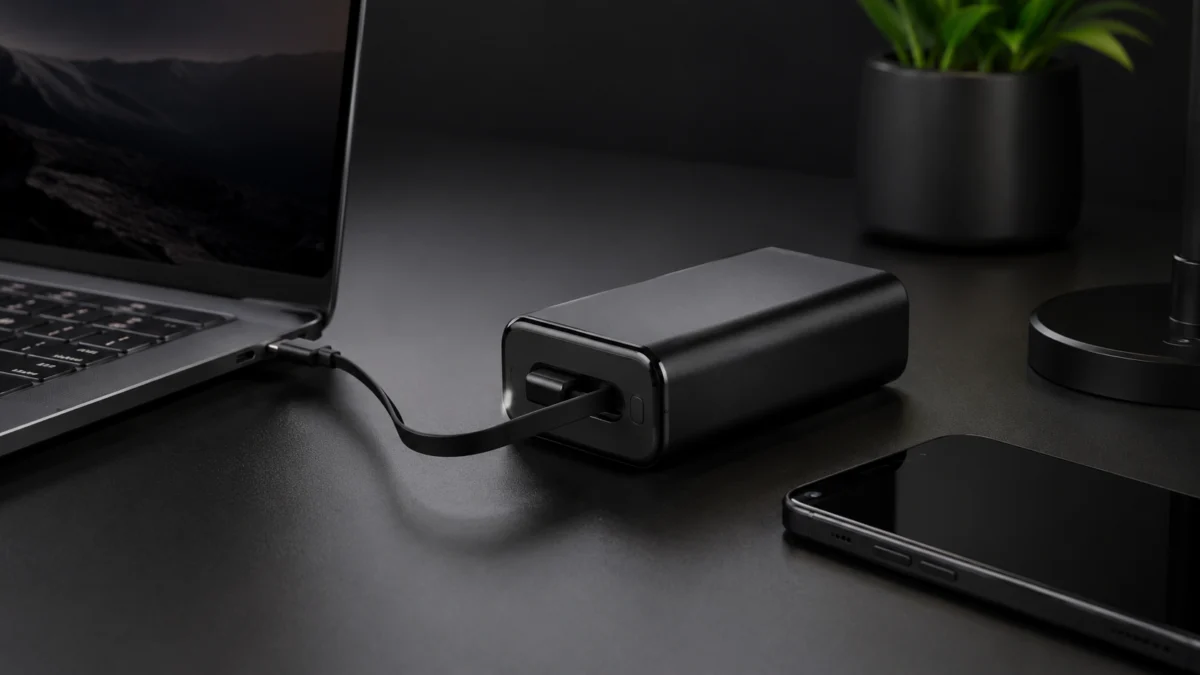
The Anker Laptop Power Bank (25K, 165W) — model A1695 — is the most
convenient all-in-one solution in its class: built-in cables, a precise
smart display, and full airline carry-on clearance at 90Wh, all in a
595g chassis. For users who charge one or two devices at a time, it
performs exceptionally well. The friction starts the moment a third
device enters the picture. At that point, the secondary ports collapse
to a shared 30W pool — turning a device marketed as a “four-device
charger” into a single-laptop power bank with trickle-speed side ports.
Buy it for what it genuinely does well. Go elsewhere if your workflow
demands simultaneous high-wattage delivery across three or more devices.
Price range: in the $110–$120 range at retail;
frequently drops into the $75–$90 range during promotional windows
Model: A1695 (retail variant A1695H11) |
Capacity: 25,000mAh / 90Wh |
Max single-port output: 100W |
Warranty: 18 months
AD — This page contains affiliate links.
✅ Pros
- Built-in retractable (70cm) and lanyard (30cm) USB-C cables eliminate the need to pack separate high-wattage cables
- 90Wh internal rating keeps it under the global 100Wh carry-on limit — no airline pre-approval required
- Dual-port mode delivers approximately 82W per port simultaneously, genuinely fast for a laptop-plus-tablet setup
- Smart display shows real-time per-port wattage, remaining capacity, and estimated time to full — far more granular than LED-dot competitors
- Single-port output peaks between 85.5W and 92W in empirical testing — sufficient to keep Legion Go, Steam Deck, and most 65W laptops running indefinitely
⚠️ Cons
- Three or more connected devices trigger a 30W shared pool across all secondary ports — fast-charging a laptop, phone, and tablet simultaneously is not possible
- Does not support USB PD 3.1 (EPR), capping all ports at 100W — MacBook Pro 16-inch users lose access to their native 140W charge rate
- “Active Cooling Mode” is software-driven thermal throttling with no physical fan — input drops to approximately 50W mid-cycle, extending actual recharge time to 1 hour and 42 minutes despite a software estimate of 1 hour and 19 minutes
- Dell XPS systems display a BIOS “slow charger” warning and cap intake at 90W regardless of the power bank’s output ceiling
- Multiple user reports document the retractable cable spring or internal wiring failing after as few as 15–20 cycles, with no consumer-serviceable repair path
Design and Build Quality
At first glance, the A1695 is unmistakably a travel device. It measures
157 × 54 × 49mm (6.18 × 2.12 × 1.93 inches) and weighs 595g — denser
than a standard power bank of this capacity, but meaningfully lighter
than Anker’s own Prime 27,650mAh (A1340), which comes in at 667g.
According to Anker’s official specifications, the internal architecture
uses five lithium-ion cells arranged in a series configuration at 18VDC,
yielding 90 Watt-hours of usable energy. That 90Wh figure is not
incidental — it sits comfortably below the 100Wh threshold that the FAA
and international aviation authorities enforce for carry-on lithium
batteries, making the A1695 flight-legal without any prior airline
approval.
The port layout gives you three USB-C ports (C1, C2, C3) and one USB-A
port. What separates the A1695 from every other power bank in this power
class is the integrated cable system: a 70cm (27.6-inch) retractable
USB-C cable that spools back into the body, and a 30cm (11.8-inch)
lanyard-style USB-C cable that doubles as a carrying handle. In practice,
this means you can leave your 100W USB-C cable at home entirely. For
daily commuters and frequent travelers, that convenience is the device’s
single strongest selling point.
The smart display on the front face is a genuine differentiator. It
shows real-time input and output wattage per port, an estimated time to
full charge, and overall battery percentage — information that competing
units in the same price range simply do not offer at this level of
granularity.
Features and Performance
Charging Protocol Support
According to Anker’s official specification sheet, the A1695 supports
USB Power Delivery (PD) 3.0, Quick Charge (QC) 3.0, Programmable Power
Supply (PPS), Smart Charge Protocol (SCP), Universal Fast Charging
Specification (UFCS), Adaptive Fast Charging (AFC), and Apple 2.4A.
PPS support is particularly relevant for Samsung Galaxy S-series users,
as it allows the power bank to dynamically adjust output voltage in
fine increments, significantly reducing heat inside the phone during fast
charging. UFCS support adds compatibility with Huawei, Oppo, and Vivo
devices as those brands standardize on that protocol.
The most important protocol gap: the A1695 does not support USB PD 3.1
(Extended Power Range). PD 3.0 is hard-capped at 100W (20V/5A). Hitting
140W — the native intake rate of the Apple MacBook Pro 16-inch — requires
PD 3.1 at 28V/5A. Because the A1695 cannot negotiate that voltage tier,
MacBook Pro 16-inch users will receive a maximum of 100W from this power
bank, not 140W. That gap extends charge times compared to a native 140W
wall adapter, though it does not prevent charging.
What “165W” Actually Means — Single Port vs. Multi-Port Reality
The 165W figure printed on the box refers to the theoretical combined
maximum across all ports simultaneously, not the output of any single
port. According to Anker’s official specifications, any individual USB-C
port is rated to a maximum of 100W.
According to wattmeter-based testing documented by TORR3NT’s Tech,
output to a heavily depleted target device peaks between 85.5W and 92W
— an 8% to 15% efficiency loss from the theoretical 100W ceiling that
accounts for heat conversion, cable resistance, and the receiving
device’s own power management. That output is entirely normal and
consistent with how lithium-ion discharge systems behave.
Two devices connected simultaneously represents the A1695’s best-case
scenario.
According to the same wattmeter testing, the unit can sustain
approximately 82W to each of two USB-C ports at the same time —
genuinely useful for a laptop-and-tablet combination.
The picture changes sharply when a third or fourth device enters the
picture. The A1695’s internal controller immediately prioritizes the
primary C1 port, allowing it to maintain up to its 100W ceiling for a
connected laptop. According to Anker’s official port distribution
specifications, the remaining output across all other ports — C2, C3,
and USB-A combined — is restricted to a shared pool of just 30W.
According to multi-port load testing documented by TORR3NT’s Tech,
connecting a MacBook, a Valve Steam Deck, and an iPhone 16 Pro Max
simultaneously produced the following results: the Steam Deck received
4W, and the iPhone received 7W. At those figures, neither device is
fast-charging in any meaningful sense. Buyers who purchase this unit
expecting to fast-charge a laptop, smartphone, and tablet concurrently
will find it mathematically cannot do so.
For a visual demonstration of this port distribution behavior captured
with a wattmeter in real time, this third-party test is directly
relevant:
Recharge Speed and the “Active Cooling Mode” Controversy
The A1695 accepts a maximum of 100W input for recharging its internal
cells, provided the internal battery level is above 25%. Below that
threshold, intake slows to protect deeply depleted cells.
According to wattmeter-based testing documented by TORR3NT’s Tech using
a 250W wall charger and a high-bandwidth cable, the full 0% to 100%
recharge cycle completed in 1 hour and 42 minutes — a meaningful gap
from the 1 hour and 19 minutes that the onboard smart display estimated
at the start of the session. During the initial phase of that same
session, intake wattage reached between 85.5W and 92W before thermal
conditions altered the trajectory.
The reason for that discrepancy is a feature Anker markets as
“Active Cooling Mode.”
Anker’s official documentation states that the internal temperature
monitoring system — marketed as “ActiveShield 2.0” — performs over
3,000,000 temperature checks per day via onboard thermistors. Within
standard engineering terminology, however, active cooling refers to
mechanical heat displacement: a fan, a liquid pump, a Peltier cooler.
Independent hardware teardowns confirm the A1695 contains no internal
fans or moving cooling components whatsoever. What Anker calls Active
Cooling Mode is, in physical reality, a software-driven thermal
throttling protocol.
According to the same wattmeter testing by TORR3NT’s Tech, when internal
temperature sensors detect the cell temperature rising to approximately
45–48°C — typically at around the 30-minute mark, when the battery
reaches 45–50% capacity — the microcontroller deliberately cuts the
input or output wattage to approximately 50W. The passive metallic heat
sinks inside the chassis then radiate that accumulated thermal energy
into the surrounding air. The throttling is a standard and necessary
safety mechanism; the naming has drawn sustained criticism from
technically literate users as misleading.
If the unit’s upper thermal limit is crossed during discharge — most
commonly when attempting to sustain the full 165W load across multiple
high-draw devices — the A1695 enters a “Protection Mode” that cuts
power delivery to all ports entirely until a passive cool-down period
completes. This is not a defect; it is the designed behavior of a
dense lithium-ion system without active airflow. The practical
consequence is a workflow interruption that users pushing three or four
devices simultaneously will encounter repeatedly.
The following unedited time-lapse documents the full 0–100% recharge
cycle and the thermal throttling event that extends the actual time
beyond the software estimate:
Real-World Use: How It Performs by Device
Dell XPS 13, 15, and 17
Dell’s laptops use proprietary charging protocols embedded in their BIOS
firmware. Because the A1695 is a third-party USB-C source, Dell firmware
enforces a hard 90W intake cap — regardless of what the power bank is
capable of delivering. Multiple users consistently report a BIOS-level
warning stating that a “slow charger” is connected. The A1695 does
successfully deliver the full 90W Dell allows, which is sufficient for
standard productivity workloads. However, if a Dell XPS with a discrete
GPU is pushed to maximum CPU and GPU utilization simultaneously —
video rendering, for instance, or 3D gaming — total system draw can
exceed 90W, causing the internal battery to slowly discharge even while
the power bank is connected. According to Anker’s official capacity
estimates, a fully charged A1695 (90Wh) can provide approximately
1.5 full charges to a Dell XPS 13 (52Wh internal battery) under
resting conditions.
Apple MacBook Pro 16-inch and MacBook Air 13-inch (M2)
Apple hardware interfaces cleanly with the A1695 via PD 3.0, pulling
up to the 100W port ceiling during single-port operation. As noted
above, the 140W native charge rate of the MacBook Pro 16-inch is not
achievable — PD 3.1 is required for that. According to Anker’s official
capacity calculations, the 90Wh power bank can provide approximately
0.8 full charges to a 16-inch MacBook Pro (100Wh internal battery) and
approximately 1.5 full charges to a 13-inch MacBook Air (M2). MacBook
Pro 16-inch users who also plug in an iPhone and an Apple Watch should
be aware that doing so triggers the 30W secondary pool restriction —
the MacBook maintains its primary draw, but auxiliary Apple devices
drop to trickle-charge speeds.
Lenovo Legion Go and Valve Steam Deck
Handheld gaming consoles represent the A1695’s clearest use case. The
Legion Go requires a minimum of 65W to charge in performance mode; the
Steam Deck draws approximately 40W under load. The A1695’s 100W
single-port output clears both thresholds comfortably, allowing either
device to run indefinitely from the power bank without the internal
battery declining. Users specifically report that the A1695 does not
exhibit significant overheating when running a single handheld console,
making it a reliable companion for long-haul flights and transit
scenarios.
Lenovo ThinkPad X1 Carbon
User reports regarding the ThinkPad X1 Carbon are generally positive,
with one documented quirk: the PD handshake sometimes settles at a
lower voltage tier, resulting in a maximum observed charge rate of 50W
rather than the higher potential of the PD protocol ceiling. According
to Anker’s official estimates, the 90Wh pack can provide approximately
1.4 full charges to a ThinkPad X1 Carbon (57Wh internal battery).
What Real Users Are Saying
Across Reddit communities (r/anker, r/powerbanks, r/gadgets) and
major retail review pages, the A1695 draws a consistent pattern of
praise and criticism that closely tracks its documented technical
characteristics.
On the positive side, the integrated cable system dominates favorable
feedback. Multiple users on r/gadgets and in Best Buy reviews describe
the built-in cables as the device’s defining advantage — eliminating
the need to source, pack, and untangle separate 100W-rated cables is
cited as a genuine quality-of-life improvement for daily commuters and
frequent travelers. The smart display’s granular per-port wattage data
is consistently highlighted as a meaningful upgrade over previous Anker
generations and over competitors in the same power class.
The 30W secondary-port bottleneck is the single most repeated negative
finding across community discussions. Several threads on r/powerbanks
and r/anker document user frustration with the severe wattage drop when
three or more devices are connected simultaneously — a limitation that
contradicts the “simultaneous four-device charging” language in Anker’s
marketing materials.
According to multiple reports on r/anker, some users have experienced
the retractable cable spring failing within the first 30 days of use,
and others report the internal wiring delivering only 0.1W of output
after as few as 15 to 20 retraction cycles — requiring the cable to be
held at a specific angle to maintain any connection at all. Because both
integrated cables are hardwired to the internal circuitry, a cable
failure cannot be repaired at home and requires initiating a warranty
replacement with Anker.
A segment of users report no degradation after 70 to 200 full cycles,
making the 18-month warranty a factor worth weighing heavily in the
purchase decision regardless of which outcome is more likely for any
given unit.
Handheld gaming users on r/LegionGo report consistent satisfaction.
Multiple posts confirm the A1695 handles Legion Go performance-mode
charging without significant thermal events during single-device use,
and specifically cite it as a strong option for long-haul flights.
How We Researched
This article is based on Anker’s official product specifications and
support documentation (Anker US product page, Anker service center
specification sheet, Anker official user guide for the A1695), empirical
output data documented in wattmeter-based video testing by TORR3NT’s
Tech on YouTube, device-compatibility reports from r/anker, r/powerbanks,
r/gadgets, r/LegionGo, and r/UsbCHardware on Reddit, and aggregate user
feedback from Best Buy customer reviews. We have not conducted hands-on
lab testing. All performance figures reflect manufacturer claims or
community-reported and third-party-measured results cited in this article.
✅ Pros
- Built-in retractable (70cm) and lanyard (30cm) USB-C cables eliminate the need to pack separate high-wattage cables
- 90Wh internal rating keeps it under the global 100Wh carry-on limit — no airline pre-approval required
- Dual-port mode delivers approximately 82W per port simultaneously, genuinely fast for a laptop-plus-tablet setup
- Smart display shows real-time per-port wattage, remaining capacity, and estimated time to full — far more granular than LED-dot competitors
- Single-port output peaks between 85.5W and 92W in empirical testing — sufficient to keep Legion Go, Steam Deck, and most 65W laptops running indefinitely
⚠️ Cons
- Three or more connected devices trigger a 30W shared pool across all secondary ports — fast-charging a laptop, phone, and tablet simultaneously is not possible
- Does not support USB PD 3.1 (EPR), capping all ports at 100W — MacBook Pro 16-inch users lose access to their native 140W charge rate
- “Active Cooling Mode” is software-driven thermal throttling with no physical fan — input drops to approximately 50W mid-cycle, extending actual recharge time to 1 hour and 42 minutes despite a software estimate of 1 hour and 19 minutes
- Dell XPS systems display a BIOS “slow charger” warning and cap intake at 90W regardless of the power bank’s output ceiling
- Multiple user reports document the retractable cable spring or internal wiring failing after as few as 15–20 cycles, with no consumer-serviceable repair path
Final Verdict
The Anker A1695 solves one problem better than any other power bank in
its class: it lets you leave your charging cables at home. The
integrated retractable cable, smart display, compact dimensions, and
guaranteed flight clearance make it the most frictionless travel
companion available at this capacity and wattage tier. For a user whose
daily workflow means charging a single laptop — or a laptop and one
other device — on the go, it is a well-engineered product that delivers
on its core promise.
The purchase case weakens for three specific groups. First, users with
MacBook Pro 16-inch machines who want the full 140W charge rate will
need a PD 3.1-capable power bank such as the Anker Prime 27,650mAh
(A1340). Second, users who regularly charge three or more high-draw
devices simultaneously will find the 30W shared secondary pool a hard
operational ceiling. Third, users who prioritize long-term mechanical
reliability over travel convenience should weigh the cable durability
reports seriously — the retractable mechanism is the device’s single
point of failure, and it cannot be field-repaired.
I’d recommend the A1695 to digital nomads, remote workers, and frequent
flyers who charge one or two devices and value an all-in-one solution
above all else. If your use case falls outside those parameters, the
UGREEN Nexode 165W offers more conservative thermal management, and the
Anker Prime A1340 removes the wattage ceiling and cable-failure risk
at the cost of additional weight.








Comments