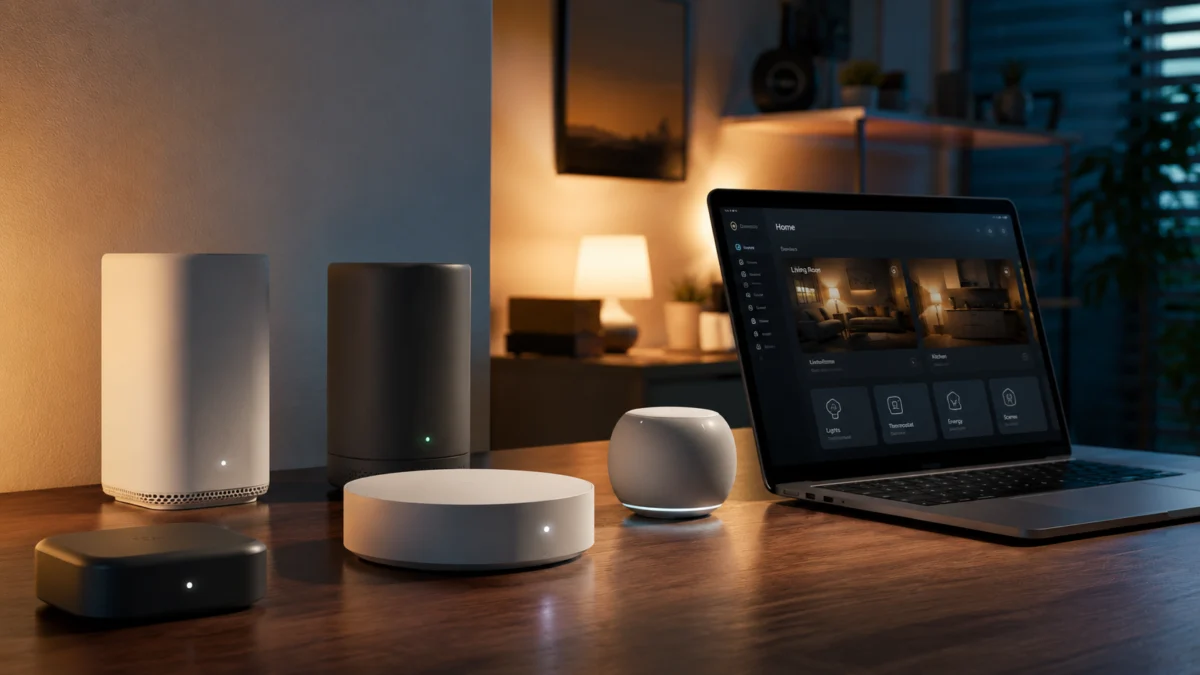
Matter 1.6 is the first major Matter release focused on fixing how your smart home is set up and shared, not on adding new device types. The headline change is Joint Fabric, a way for multiple platforms—like Apple Home, Google Home, and SmartThings—to co-manage a single Matter network through a shared central datastore instead of each keeping its own separate copy. It also adds full NFC-based commissioning and a smarter way to handle thermostat commands. The catch is simple but important: the specification being published is not the same as the feature working on your hardware today. According to the official rollout pattern, most ecosystems still have to ship updates before Joint Fabric becomes usable. This guide breaks down what changed, how Joint Fabric differs from the multi-admin setup you already know, and which ecosystems are actually ready.
What Changed in Matter 1.6?
Matter 1.6 is an infrastructure and setup-experience release rather than a new-device release. Where Matter 1.5 added device categories like cameras and robot vacuums, 1.6 focuses on three things: Joint Fabric for shared network administration, NFC-based commissioning for tap-to-setup, and Thermostat Suggestions for context-aware climate control.
According to the Connectivity Standards Alliance (CSA), the goal of Matter 1.6 is to reduce the friction between physically installing a device and getting it configured across software. The three core additions are:
- Joint Fabric — lets multiple approved controllers co-administer one shared Matter network through a central datastore, instead of each ecosystem maintaining its own separate fabric.
- NFC-based commissioning — allows the entire setup handshake to complete over NFC alone, even when the device has no power yet.
- Thermostat Suggestions — standardizes climate commands as time-limited suggestions a thermostat can evaluate, rather than absolute orders it must obey.
These are spec-level capabilities. Whether you can use them right now depends on your specific platform shipping support for them—which is the gap this article keeps coming back to.
What Is Joint Fabric, and How Is It Different from Multi-Admin?
Joint Fabric lets several approved controllers manage one shared Matter network through a central datastore, and—critically—it counts as a single fabric on the device. Enhanced Multi-Admin instead created a separate fabric for each ecosystem you added, consuming the device’s limited fabric slots far faster. That slot exhaustion is the root of many failures people see today.
To understand why this matters, you need to know what a “fabric” is. In Matter, a fabric is a logical network partition—essentially one ecosystem’s private view of a device. The Matter specification requires certified devices to support at least five fabrics at once. That sounds like plenty until you see how quickly slots get used:
| Approach | How devices are shared | Fabric slots consumed |
|---|---|---|
| Enhanced Multi-Admin (Matter 1.4 / 1.5) | Each ecosystem creates and syncs its own separate fabric when a device is added | One slot per ecosystem (and some platforms consume more than one) |
| Joint Fabric (Matter 1.6) | Multiple controllers co-administer one shared network via a central datastore | Counts as a single fabric, regardless of how many controllers join |
According to reporting on the specification, Apple Home alone consumes two fabric slots because it syncs across devices through iCloud Keychain. Stack Apple Home, Google Home, and Home Assistant together and a five-slot device can run out of room, which is what produces the “ghost device” problem—online in one app, offline in another.
Joint Fabric is designed to remove that ceiling. Because every participating controller shares one fabric, hardware added to the Joint Fabric becomes immediately accessible to all of them, and administrators can be added or removed without touching the physical device’s configuration. That makes it especially relevant for new-construction handovers, mixed-platform households, and professionally managed properties.
Does Matter 1.6 Make Setup Easier?
Yes, in one specific way: NFC-based commissioning. In Matter 1.6, the full commissioning exchange can complete over two-way NFC alone, so you can tap your phone to an unpowered switch or ceiling fixture and store its network credentials before the power is even on. But network-environment problems—like Wi-Fi band steering or VPN interference—can still cause setup to fail.
Previously, even when NFC tags carried setup information (added in Matter 1.4.1), the actual commissioning still depended on a Bluetooth Low Energy (BLE) handshake, and the device had to be powered on. If the BLE connection dropped, setup failed. Matter 1.6 changes this by encapsulating the commissioning messages into chained ISO/IEC 7816-4 command-response pairs, letting the credentials write directly to the device’s internal NVRAM. When the breaker is later switched on, the device boots and authenticates to the network automatically.
This removes a real pain point for hard-to-reach hardware installed high on walls or inside ceilings. What it does not remove are the network-side failures that frustrate people today. According to multiple community reports, some users see commissioning fail silently in specific environments, most commonly when:
- A router’s band-steering feature pushes the phone onto 5 GHz while the device needs the 2.4 GHz band, causing the handshake to time out with no clear error.
- A VPN is active on the phone, blocking the local multicast traffic the phone and device need to discover each other.
NFC commissioning simplifies the physical step, but these network conditions are independent of which Matter version you run.
Matter 1.6 vs. Thread 1.4 — Don’t Confuse the Two
Matter and Thread operate on completely different layers. Matter is the application-layer language defining how devices describe themselves and accept commands. Thread is the wireless mesh that carries that traffic. Joint Fabric (Matter 1.6) solves administrative sharing; Thread 1.4 credential sharing solves wireless mesh unification. They are separate fixes for separate problems.
| Matter 1.6 | Thread 1.4 | |
|---|---|---|
| Layer | Application layer (the common device language) | Transport / network layer (low-power IPv6 wireless mesh on IEEE 802.15.4, 2.4 GHz) |
| What it unifies | Administration — how ecosystems share and manage devices | The wireless mesh — how different vendors’ border routers form one network |
| Headline change | Joint Fabric (shared network administration) | Credential sharing (standardized in late 2024) |
Why this distinction matters in practice: in older Thread 1.3 setups, an Apple HomePod and an Amazon Echo in the same home could each build their own separate Thread mesh, causing interference and dropouts—a fragmented border-router problem. Thread 1.4 introduced credential sharing so routers from different vendors can join one unified mesh.
The key takeaway: “I added a Thread 1.4 router and my mesh is stable now” and “Joint Fabric lets my devices share seamlessly between Apple and Google” are two entirely different technical outcomes. Solving one does not solve the other.
Which Ecosystems Are Actually Ready? (Apple, Google, SmartThings, Alexa, Home Assistant)
As of mid-2026, no major consumer ecosystem has confirmed full end-user Joint Fabric support, even though several have already shipped Thread 1.4 mesh support. In short: the spec is public, but Matter 1.6’s flagship feature is still waiting on platform updates. The table below separates the two layers so you can see exactly where each platform stands.
| Platform | Thread 1.4 (mesh unification) | Matter 1.6 / Joint Fabric | Notes |
|---|---|---|---|
| Samsung SmartThings | Shipped (per reports, in late-2025 app updates) | Not yet confirmed (Matter 1.5 supported) | Border routers built into some Samsung TVs and soundbars; reportedly the most active on interoperability |
| Apple Home | Shipped (per reports, with tvOS / iOS updates) | Not yet confirmed | Relies on iCloud Keychain for its own syncing; timing for a central-datastore approach is unclear |
| Google Home | Shipped (per reports, via Google TV Streamer update) | Not yet confirmed | Public focus has been on AI features; no specific Joint Fabric roadmap stated |
| Home Assistant | Shipped (via OpenThread) | In progress (per reports, Matter Server reached 1.5.1; 1.6 expected soon) | Most flexible and community-driven; fastest implementation expected but requires technical knowledge |
| IKEA (Dirigera) | Shipped (per reports, firmware 2.805+) | Partially in progress (becoming a Matter controller) | Pushing low-cost Matter-over-Thread devices into the market |
| Amazon Alexa | Not yet confirmed (many devices reportedly still on older Thread) | Not yet confirmed | Platform updates widely viewed as lagging peers |
Treat every “not yet confirmed” entry as exactly that—unconfirmed at the time of writing, pending each platform’s own announcements. The practical lesson from the community is consistent: a “Matter 1.6 compatible” label on a box does not tell you which specific 1.6 features your platform can actually use today.
Should You Buy Matter Devices Now or Wait?
You can buy Matter devices now—but verify one hardware constraint first: the Wi-Fi-only Apple TV 4K has no Thread radio, so border-router use requires the Ethernet model. For everything else, buying now is reasonable as long as you treat Joint Fabric as a future benefit, not a current one.
Buy now if:
- You need the device’s core function today and don’t depend on Joint Fabric working immediately.
- You’re choosing a hub or border router and want one positioned to receive future Matter 1.6 / Thread 1.4 updates.
- You’re standardizing on one ecosystem rather than trying to share seamlessly across several right now.
Hold off if:
- Your main reason to buy is seamless cross-ecosystem sharing via Joint Fabric—that feature is still waiting on platform updates.
- You’re counting on an existing older device automatically gaining Joint Fabric. Whether it does depends on the OEM shipping a firmware update, and some older hardware may never get it.
When you do shop for a future-proof hub or border router, these are the common U.S.-market starting points worth checking for current availability and ecosystem fit. Pricing and stock are verified separately before publication.
Disclosure: This section contains affiliate links. As an Amazon Associate, Fixory may earn from qualifying purchases.
| Ecosystem | Hardware | What to check before buying |
|---|---|---|
| Apple | Apple TV 4K (Wi-Fi + Ethernet model) | Must be the Ethernet model — the Wi-Fi-only version has no Thread radio |
| Apple | HomePod mini / HomePod (2nd gen)
HomePod (2nd gen) on Amazon |
Cheapest way to add a Thread border router in the Apple ecosystem |
| Google TV Streamer | Chromecast successor; acts as a Thread 1.4-capable hub | |
| Samsung | SmartThings Station / Aeotec Smart Home Hub
Aeotec hub on Amazon |
Among the most consistent at tracking the latest Thread / Matter specs |
| Independent | IKEA Dirigera Hub | Strong low-budget Matter controller after recent firmware updates |
| Power user | Home Assistant Yellow / ZBT-1 USB dongle | Most flexible, but self-managed; expects technical comfort |
| Network | Amazon eero 7 | Wi-Fi 7 router with a built-in Thread border router |
Related buying guides: Matter security cameras, Matter smart plugs with energy monitoring, and UWB smart locks.
Frequently Asked Questions
Will my existing Matter devices get Joint Fabric automatically?
Not automatically. Joint Fabric support depends on the device manufacturer shipping a firmware update for that specific product. Some older hardware may receive it; some may not get it at all. Check the manufacturer’s support page for your model before assuming it will gain Joint Fabric.
Is “Matter 1.6 compatible” the same as being usable today?
No. A “Matter 1.6 compatible” label refers to the specification, not to whether your ecosystem app has implemented a given 1.6 feature. As of mid-2026, most major platforms have not yet confirmed full Joint Fabric support, so a compatibility label alone does not mean the feature works in your setup.
Do I need new hardware to use Matter 1.6?
It depends on the feature. Joint Fabric and NFC commissioning generally require both updated controllers and, in some cases, updated devices. If you already own a recent hub or border router, you may only need software updates—but cross-ecosystem sharing still waits on each platform shipping support.
How We Researched
This article is based on a Deep Research report compiled from the Connectivity Standards Alliance’s official Matter 1.6 announcement and specification materials, manufacturer and platform documentation, technical explainer publications, and recurring community reports from forums such as Reddit’s r/homeassistant and r/HomeKit. We have not conducted hands-on lab testing. Any specification details are attributed to official sources, and any user-experience patterns are identified as community reports rather than verified by us. Per-ecosystem implementation status is current as of mid-2026 and is subject to each platform’s own announcements.
The Bottom Line
Matter 1.6 is a meaningful step in the right direction. Joint Fabric directly targets the fabric-exhaustion and ghost-device problems that make multi-platform smart homes frustrating today, NFC commissioning removes a real installation headache, and Thermostat Suggestions makes cross-ecosystem climate control less of an override battle. But the specification arriving and the features working on your hardware are two different milestones. Today, the things worth acting on are practical: pick hubs and border routers positioned for future updates, verify hardware constraints like the Apple TV 4K Ethernet requirement, and read past “Matter 1.6 compatible” labels to ask which specific features your platform actually supports. The thing not to overexpect is instant, seamless sharing across Apple, Google, Amazon, and SmartThings—that depends on each company shipping Joint Fabric, and most have not confirmed it yet.