
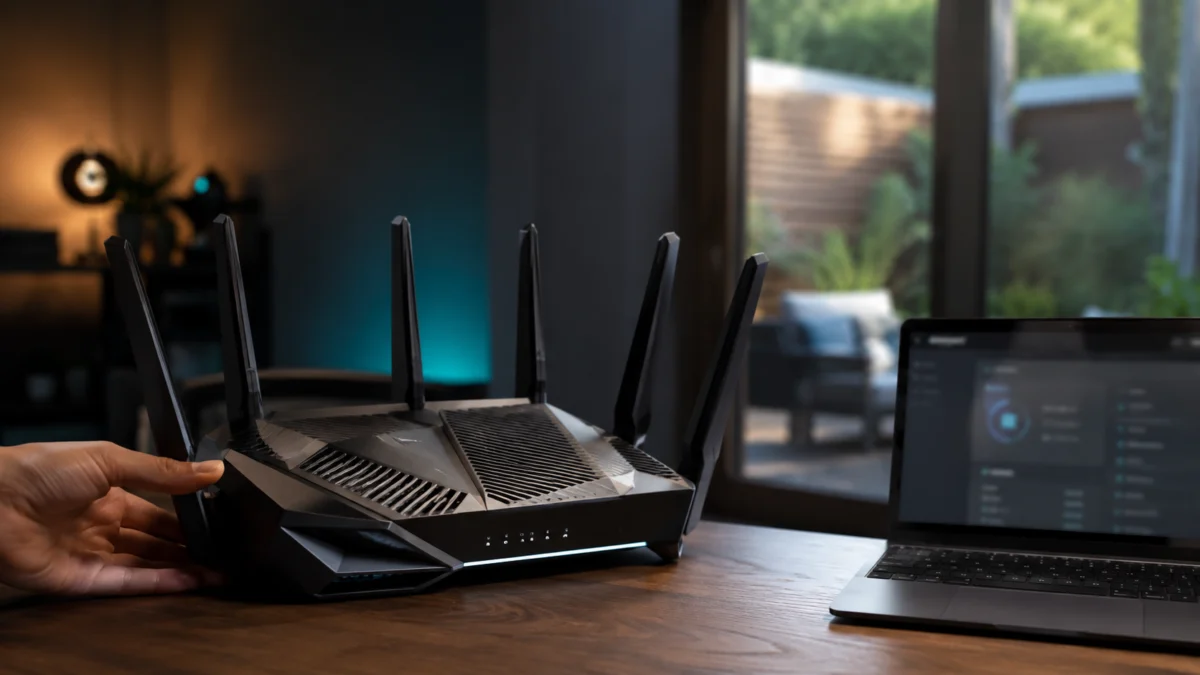
AFC — Automated Frequency Coordination — is not a speed-boost feature for Wi-Fi 7. It is the regulatory coordination system that makes Standard Power 6GHz operation legal in the United States. Without AFC, every Wi-Fi 7 router with a 6GHz radio defaults to Low Power Indoor mode, which limits how far the 6GHz signal travels. With AFC enabled, a router can switch to Standard Power mode, extending 6GHz range by roughly 25% — enough to bring it in line with the 5GHz band.
For most homes with a centrally placed router, LPI mode is sufficient. But for large homes, garages, outdoor coverage, and detached spaces, AFC matters. This guide explains what AFC actually is, who genuinely benefits from it, and what to check before paying more for an AFC-capable router.
What Is AFC in Wi-Fi 7?
AFC — Automated Frequency Coordination — is a cloud-based spectrum management system that allows Wi-Fi 7 access points and routers to operate in Standard Power mode on the 6GHz band. In Standard Power mode, a router can transmit at up to 36 dBm EIRP on the 6GHz band, compared to a maximum of 30 dBm in the default Low Power Indoor mode.
The 6GHz band was originally used exclusively by licensed services: public safety agencies, utility companies, fixed microwave links, and satellite operators. When the FCC opened portions of the 6GHz band for unlicensed Wi-Fi use starting with Wi-Fi 6E, it required safeguards to prevent interference with those incumbent licensees. AFC is how that coordination works.
When a Standard Power access point wants to transmit on the 6GHz band, it first contacts an AFC server with its geographic location and requested frequencies. The AFC system cross-references a database of licensed 6GHz users at that location and returns a list of approved channels and maximum power levels. The access point must repeat this check every 24 hours to maintain compliance.
The FCC gave operational approval to seven AFC systems in February 2024, opening the door for consumer and commercial routers to begin offering Standard Power 6GHz support in the United States.
AFC is not a Wi-Fi 7 exclusive concept — it applies to Wi-Fi 6E hardware as well — but it has become significantly more relevant with Wi-Fi 7 because the 6GHz band is central to the standard’s headline features, including 320MHz channels and Multi-Link Operation.
Low Power Indoor vs. Standard Power 6GHz: The Key Difference
The difference between LPI and Standard Power comes down to output and location rules. LPI allows indoor-only operation at up to 30 dBm EIRP and requires no AFC coordination. Standard Power allows both indoor and outdoor operation at up to 36 dBm EIRP, but only under AFC control.
In practical terms, the 6 dBm increase in maximum transmit power translates to a meaningful range improvement. According to the FCC’s framework and confirmed by router manufacturers, Standard Power mode extends the 6GHz band’s effective range to roughly match that of the 5GHz band — approximately 25% further than LPI mode allows.
There is an important nuance here: the power uplift is not uniform across all channel widths. Based on published specifications, the theoretical gain at 160MHz — the most common channel width among current 6GHz-capable laptops and smartphones — is approximately 1.6x at mid-to-long ranges beyond about 52 feet. At 320MHz, the gain is roughly 4x. The headline “63x improvement” figures sometimes cited in marketing materials apply to 20MHz channels, which are not the typical operating condition.
| Mode | Max EIRP | Location | AFC Required | Bands Available |
|---|---|---|---|---|
| Low Power Indoor (LPI) | 30 dBm | Indoor only | No | All 6GHz UNII sub-bands |
| Standard Power (SP) | 36 dBm | Indoor and outdoor | Yes | UNII-5 and UNII-7 only |
One key restriction with Standard Power mode: it is limited to two specific portions of the 6GHz band — UNII-5 (5.925–6.425 GHz) and UNII-7 (6.525–6.875 GHz). LPI can operate across all 6GHz UNII sub-bands, which gives it broader channel flexibility indoors even at lower power.
Also worth noting: AFC is entirely opt-in. Enabling Standard Power mode requires the router to share its location with a cloud server. If AFC is not configured, the router continues operating in LPI mode by default, and no location data is shared.
Does AFC Actually Improve 6GHz Range?
Yes, but with important caveats. AFC enables Standard Power mode, which increases 6GHz transmit power by up to 6 dBm over LPI. In practical terms, this closes roughly 75% of the range gap between 6GHz and 5GHz bands. However, range in any real home depends on far more than transmit power alone.
Several factors limit 6GHz range independently of AFC status:
- Wall materials: Concrete, brick, and metal significantly attenuate 6GHz signals regardless of power level.
- Router placement: A router tucked in a corner or closet will not distribute 6GHz signal effectively even in Standard Power mode.
- Client device support: Both the router and the connecting device must support 6GHz. Older laptops and phones that lack 6GHz radios are unaffected by AFC entirely.
- Channel width and congestion: Wide 320MHz channels on 6GHz offer the fastest throughput but over shorter distances. Narrower channels travel further but reduce peak speed.
- Antenna design: Internal antenna designs, common in many consumer routers, have lower gain than external antenna configurations.
The range improvement from Standard Power mode is most noticeable beyond roughly 50 feet from the router, especially in open spaces or through a single interior wall. In a compact apartment or small home where 6GHz already performs reliably in LPI mode, AFC provides minimal observable benefit under typical conditions.
Who Actually Needs a Standard Power Wi-Fi 7 Router?
Standard Power 6GHz via AFC is worth prioritizing for users who have a specific coverage challenge that LPI mode cannot solve — not for buyers who simply want faster Wi-Fi across a typical home.
The following situations are where Standard Power 6GHz delivers real value:
- Large homes with dead zones on 6GHz: If you have a home over approximately 2,000–2,500 square feet and a single router, 6GHz in LPI mode may not reliably reach the far end. Standard Power mode extends that reach without requiring a mesh node.
- Outdoor coverage: The FCC does not permit LPI for outdoor 6GHz use. Standard Power under AFC is the only legal path to 6GHz coverage in a backyard, on a deck, or at an outdoor workspace. For any outdoor 6GHz setup, AFC-capable hardware is a requirement, not an option.
- Attached garage, basement, or detached office: Spaces physically separated from the main living area by thick walls or structural elements are where the LPI range limitation is most commonly felt. Standard Power mode can improve 6GHz penetration in these scenarios.
- Maximizing MLO at longer ranges: Wi-Fi 7’s Multi-Link Operation feature bonds 5GHz and 6GHz simultaneously for higher throughput and stability. In LPI mode, the 6GHz component of an MLO link drops out earlier as distance increases. Standard Power mode expands the zone where both bands remain active together.
- Small office or prosumer setups: Users running several 6GHz-capable devices across a wider floor plan may benefit from the additional headroom Standard Power provides.
Who Doesn’t Need AFC Yet?
For a majority of home users, AFC support is not a necessary purchase criterion today. An AFC-capable router costs more and adds setup complexity that most buyers never need to use.
You likely do not need AFC if:
- Your home is small or medium-sized and router placement is central: If your router sits in a living room, hallway, or open-plan area and 6GHz already reaches your primary devices reliably, LPI mode provides everything you need.
- You are not using outdoor Wi-Fi 7: AFC for outdoor coverage requires specific setup and location sharing. If all your devices are indoors, LPI is the simpler and fully adequate choice.
- Your devices do not support 6GHz: AFC improves the 6GHz band specifically. Devices limited to 2.4GHz or 5GHz are entirely unaffected.
- You are in a location where AFC may not be approved: AFC availability depends on your specific geographic location in relation to licensed 6GHz users. In some areas, the AFC system may restrict Standard Power use or limit available channels. This cannot be predicted without checking at your address.
- You prefer simpler setup: AFC requires enabling via a companion app with location permission on a smartphone. Users who want plug-and-play networking can skip the feature entirely and run 6GHz in LPI without any configuration.
A well-placed Wi-Fi 7 router in LPI mode, combined with a mesh satellite if needed for coverage, will outperform a poorly placed AFC-enabled router in most homes.
How to Check Whether a Wi-Fi 7 Router Supports AFC
Not all Wi-Fi 7 routers support AFC. Tri-band Wi-Fi 7 routers include a 6GHz radio, but Standard Power certification and AFC support require additional hardware qualification and FCC device certification beyond basic Wi-Fi 7 compliance. Here is what to check before buying.
Step 1: Look for “Standard Power” or “AFC” in the official spec sheet
Check the manufacturer’s official product page under the wireless specifications section. Look for explicit mentions of “Standard Power 6GHz,” “AFC support,” or “Automated Frequency Coordination.” Vague language like “6GHz Wi-Fi 7” or “tri-band” does not confirm AFC support.
Step 2: Confirm regional availability
As of the time of this writing, AFC for consumer routers is available in the United States and Canada. Other regions including the European Union operate under different 6GHz regulatory frameworks and do not currently use the same AFC system. If you are purchasing outside the US or Canada, confirm whether AFC is supported in your country before prioritizing this feature.
Step 3: Check setup requirements
AFC-capable consumer routers typically require a companion smartphone app to enable Standard Power mode. The app uses your device’s location data to register the router’s position with the AFC cloud service. Confirm that this setup process is supported for the specific model you are considering and that the manufacturer’s AFC service is operational.
As one confirmed example, the ASUS ROG Strix GS-BE18000 supports AFC via the ASUS Router smartphone app, which passes location data to the AFC system for Standard Power authorization. Other AFC-capable models exist; check the manufacturer’s current product documentation for confirmation before purchase.
Check on Amazon
/
Official site
AFC, Outdoor Wi-Fi 7, and Large Homes: What to Expect
For outdoor 6GHz coverage, AFC is not optional — it is mandatory. The FCC prohibits Low Power Indoor mode from being used outdoors. Any Wi-Fi 7 router or access point that transmits on the 6GHz band outdoors must do so in Standard Power mode under AFC control.
This has practical implications:
- If you want 6GHz connectivity in your backyard, on a patio, or in a detached structure, your router or access point must be AFC certified and properly configured.
- Standard Power mode must be actively enabled — it does not activate automatically just because the router is placed near a window or door.
- The AFC server determines available channels and power limits based on your location. In some areas near existing 6GHz licensees, the AFC system may restrict which channels are available or cap power below the 36 dBm maximum.
For large homes, the picture is more nuanced. Standard Power mode extends the 6GHz signal footprint, but structural attenuation from thick walls, floors, and building materials remains a limiting factor regardless of transmit power. In a large home with multiple physical barriers, a mesh Wi-Fi system may deliver more consistent coverage than a single AFC-enabled router operating in Standard Power mode.
That said, for a large open-plan home or a home where the signal needs to reach a detached garage or a backyard entertainment area, AFC-capable hardware is the most direct path to extending 6GHz coverage legally and effectively.
AFC vs. MLO: Don’t Confuse These Two Wi-Fi 7 Features
AFC and MLO are entirely separate features that serve different purposes, but they interact in one important way. Confusing them is common because both relate to Wi-Fi 7’s 6GHz capabilities and both involve technical setup requirements.
| Feature | What it does | Requires AFC? |
|---|---|---|
| AFC | Regulates 6GHz transmit power by coordinating with a cloud database of licensed spectrum users. Enables Standard Power mode. | AFC is the system itself |
| MLO (Multi-Link Operation) | Allows a Wi-Fi 7 device to send and receive data across multiple bands simultaneously — for example, 5GHz and 6GHz at the same time. | No — MLO works independently of AFC |
MLO does not require AFC to function. A Wi-Fi 7 router without AFC support can still use MLO in LPI mode on the 6GHz band.
Where AFC and MLO interact: Standard Power mode expands the distance at which a connected device can maintain a reliable 6GHz connection. Since MLO typically bonds 5GHz and 6GHz together, a larger 6GHz coverage zone means MLO’s combined link remains active over a greater area. In practical terms, AFC makes MLO more useful in larger spaces.
If you are researching Wi-Fi 7 due to MLO disconnection issues or unstable multi-band behavior, AFC is not the fix. MLO stability problems are separate from transmit power and relate to driver support, client device compatibility, and firmware behavior.
Buying Checklist Before You Pay More for an AFC-Capable Router
Before prioritizing AFC support in your purchase decision, work through the following questions. If most answers point toward LPI being sufficient, a non-AFC Wi-Fi 7 router is the more practical choice for your situation.
-
Do you have 6GHz dead zones today?
If your current 6GHz devices connect reliably throughout your home in LPI mode, AFC adds little practical benefit indoors. -
Do you need outdoor 6GHz coverage?
If yes, AFC is required. No AFC support means no outdoor 6GHz use under FCC rules. -
Does the specific model explicitly list “Standard Power” and “AFC” in its spec sheet?
Tri-band Wi-Fi 7 and AFC support are different things. Confirm the feature is present in the official documentation, not just implied by marketing copy. -
Are you in a location where AFC is operational?
AFC availability depends on your geographic proximity to licensed 6GHz users. In some areas, Standard Power mode may be restricted or unavailable even on an AFC-certified router. -
Are your client devices 6GHz-capable?
AFC exclusively benefits the 6GHz band. If the devices you care most about — laptop, gaming console, smartphone — do not support 6GHz, AFC provides no advantage. -
Are you comfortable with app-based setup and location sharing?
AFC requires enabling through a companion app and sharing your device’s location to register with the AFC cloud system. This is opt-in, but it is a real setup step.
How We Researched
This article is based on official FCC documentation and announcements, Wi-Fi Alliance AFC program materials, manufacturer official documentation and support pages (including ASUS and RUCKUS Networks), Cisco’s published AFC FAQ, and independent technical analysis published by hardware and networking publications. We have not conducted hands-on lab testing of AFC-capable hardware. All performance figures reflect manufacturer-published specifications and regulatory documentation from primary sources. Where specific figures are cited, sources are noted inline.
Final Verdict: Should Home Users Care About AFC Right Now?
The answer depends on your specific home setup, not on Wi-Fi 7 as a general category.
If you have a compact or medium-sized home and your router placement is central:
You do not need AFC. LPI mode on 6GHz delivers full Wi-Fi 7 performance at the distances most home users actually operate. A well-placed tri-band Wi-Fi 7 router without AFC support will outperform a poorly configured AFC router in nearly every typical scenario. Save the budget for a mesh satellite if coverage is the real issue.
If you need outdoor 6GHz coverage or have a large home with documented dead zones:
AFC is worth specifically looking for. It is the only legal path to outdoor 6GHz in the United States, and it genuinely extends the 6GHz footprint indoors for spaces beyond roughly 50 feet with open lines of sight. Confirm that the specific model you are considering carries both FCC device certification for Standard Power and an operational AFC companion app before purchasing.
If AFC support is not confirmed in your router’s official spec sheet:
Do not assume it is present. AFC requires separate hardware certification beyond standard Wi-Fi 7 compliance. “Tri-band Wi-Fi 7” and “6GHz support” do not imply AFC. Check the manufacturer’s documentation directly before making a purchase decision based on this feature.
AFC is a genuine technical improvement for the right use cases. For most home buyers today, it is a future-proofing consideration rather than an immediate necessity — but knowing what it does and what to look for puts you in a better position to make the right call for your specific setup.
Frequently Asked Questions
What is Wi-Fi 7 AFC?
AFC (Automated Frequency Coordination) is a cloud-based system that lets a Wi-Fi 7 router operate in Standard Power mode on the 6GHz band. Before transmitting, the router sends its location to an AFC server, which checks a database of licensed 6GHz users and returns the approved channels and power limits. It is the regulatory coordination that makes higher-power 6GHz legal — not a speed feature.
What is 6GHz extended range mode?
On a Wi-Fi 7 router, longer 6GHz range comes from Standard Power mode, which AFC unlocks. Standard Power raises the maximum 6GHz output to 36 dBm EIRP, up from 30 dBm in the default Low Power Indoor (LPI) mode. That extra power extends the effective 6GHz range to roughly match the 5GHz band — about 25% farther than LPI allows. Router makers may label this setting differently, so check your model’s documentation for the exact name and whether it is supported.
Do you need AFC for a home Wi-Fi 7 router?
For most homes, no. If your router is centrally placed and 6GHz already reaches your devices reliably in Low Power Indoor mode, AFC adds little practical benefit indoors. It mainly matters for large homes with 6GHz dead zones, outdoor coverage, or spaces separated by thick walls such as a detached garage or office.
Does AFC make Wi-Fi 7 faster?
No. AFC does not raise Wi-Fi 7’s peak speed. It enables Standard Power mode, which extends 6GHz range — so you can stay on the faster 6GHz band farther from the router — but it does not increase the maximum throughput itself. Real-world speed also depends on wall materials, router placement, channel width, and whether your device supports 6GHz.
Is AFC available in every country?
No. As of this writing, AFC for consumer routers is available in the United States and Canada. Other regions, including the European Union, operate under different 6GHz regulatory frameworks and do not currently use the same AFC system. Confirm availability for your country before prioritizing this feature.



Comments