
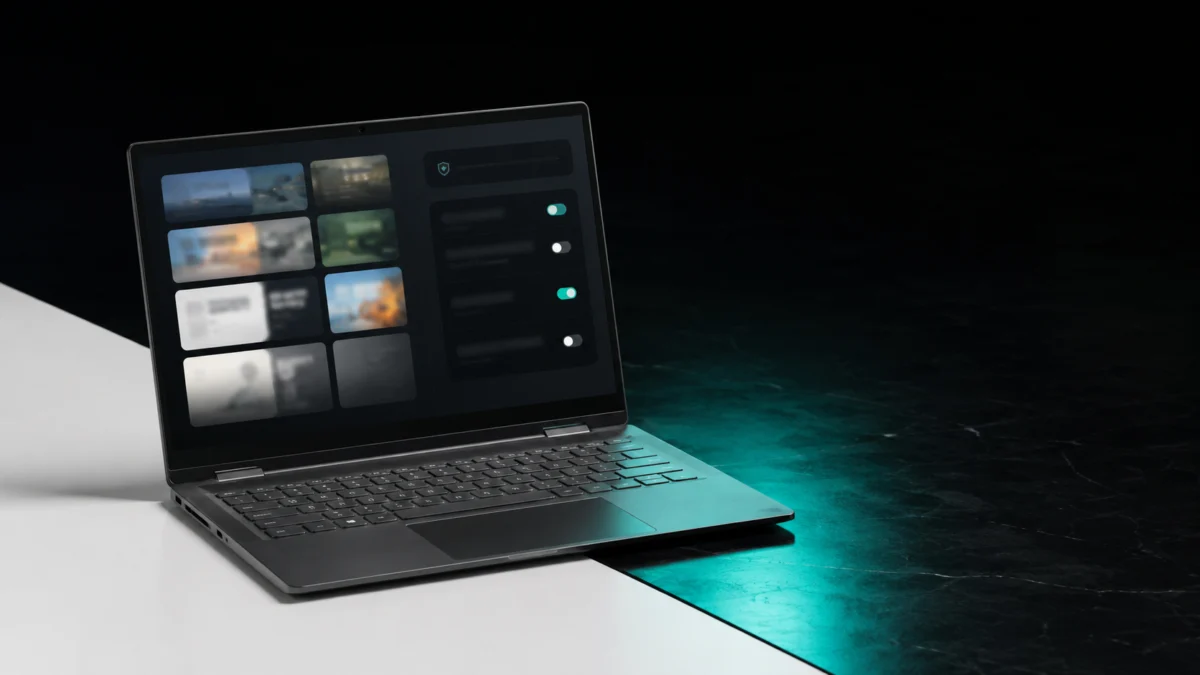
⚠️ Note: Windows Recall is under active development. Exact menu labels and settings paths may vary depending on your Windows 11 version and update history. All steps in this article reflect Windows 11 24H2 with the May 2025 cumulative update (KB5058411) or later. Check Settings → Windows Update to confirm your device is fully up to date before following these steps.
If you’ve just set up a Copilot+ PC — or heard about Windows Recall in the news — you’re likely asking one of these questions: Is it running on my device right now? How do I turn it off for good? Can I block just specific apps instead of everything? And if you’ve opened Settings looking for the “Recall & snapshots” option only to find it isn’t there, you’re not alone.
This guide covers every control Microsoft gives you over Recall: how to pause it, disable it, uninstall it completely, and exclude individual apps and websites from its snapshot capture. We also explain the most common reasons the settings page goes missing — and how to determine whether Recall is even relevant to your device.
Quick Fix Checklist
- Confirm your PC is a Copilot+ PC with a qualifying NPU (≥ 40 TOPS). If not, Recall is not available on your device — no action needed.
- Open Settings → Privacy & security → Recall & snapshots and check whether Save snapshots is toggled on or off.
- If “Recall & snapshots” is missing from Settings, check whether your Windows 11 is fully updated (Settings → Windows Update → Check for updates).
- If you want to stop snapshot capture immediately, toggle Save snapshots to Off and select Delete snapshots to remove existing data.
- If you want Recall completely removed from your system, use Turn Windows features on or off and uncheck Recall.
Does Your PC Actually Support Windows Recall?
Recall is exclusive to Copilot+ PCs — a device category defined by specific hardware requirements. Standard Windows 11 PCs, even fully updated ones, do not have access to Recall. If “Recall & snapshots” doesn’t appear in your Settings, this is the most common explanation.
Copilot+ PC hardware requirements
According to Microsoft’s official documentation, a device qualifies as Copilot+ and is eligible for Recall when it meets all of the following conditions:
- NPU with at least 40 TOPS (Tera Operations Per Second). Qualifying processors include Qualcomm Snapdragon X, Snapdragon X Plus, and Snapdragon X Elite; AMD Ryzen AI 300 series; and Intel Core Ultra 200V series.
- Windows 11 24H2 with the April 2025 non-security preview update (KB5055627) or the May 2025 Patch Tuesday update (KB5058411) installed.
- At least 256 GB of total storage with a minimum of 50 GB of free space. Recall automatically pauses snapshot saving if free space drops below 25 GB.
- BitLocker or device encryption enabled.
- Windows Hello Enhanced Sign-in Security (ESS) with at least one biometric method — face recognition or fingerprint — enrolled.
How to check if Recall is installed on your device
Open the Start menu and type Recall in the search bar. If the Recall app appears in results, it is installed. If nothing appears, your device either does not meet the hardware requirements or the feature has been uninstalled previously. You can also go to Settings → Privacy & security and look for the Recall & snapshots entry — its presence or absence is the quickest indicator.
What Recall Records — and What It Doesn’t
Recall works by taking a screenshot of your screen approximately every five seconds, but only when the on-screen content changes. According to Microsoft’s official privacy documentation, these snapshots are stored locally and encrypted on your device. Recall’s AI processing runs entirely on the device’s NPU — no snapshots or associated data are sent to Microsoft or any third party.
Default exclusions built in by Microsoft
Several categories of content are excluded from Recall snapshots by default, without any configuration required from you:
- Private or incognito browsing sessions in Microsoft Edge, Google Chrome, Firefox, and Opera
- Password entry fields in all applications
- Content protected by Digital Rights Management (DRM)
- Screen activity while Windows Game Mode is active
- Audio and continuous video (Recall does not record sound or full-motion video)
- Other users’ sessions on the same device — each user account’s snapshots are separate and inaccessible to other accounts
What the “Filter sensitive information” setting actually misses
Microsoft introduced a “Filter sensitive information” toggle designed to prevent Recall from capturing passwords, credit card numbers, and similar data. However, independent security testing published by Jetico in August 2025 confirmed that the filter does not reliably catch all sensitive content. Credit card numbers, expiration dates, CVC codes, and passwords not formatted in ways the filter recognizes were still captured in snapshots during testing. We flag this not to alarm you, but to set accurate expectations: the filter is a partial safeguard, not a complete one. For users who handle financial, medical, or confidential professional data on their devices, the exclusion filter alone is not a substitute for disabling or uninstalling Recall entirely.
How to Turn Off Windows Recall Without Uninstalling It
This method stops Recall from taking new snapshots while keeping the app installed. You can re-enable it at any time.
- Open Settings (Windows key + I).
- Select Privacy & security from the left sidebar.
- Click Recall & snapshots.
- Toggle Save snapshots to Off. Recall will immediately stop capturing screenshots.
- To remove data already collected, click Delete snapshots, then select Delete all to erase the entire snapshot history, or choose a specific time period or app.
You can also pause Recall temporarily from the system tray — look for the Recall icon (shaped like an eye) near the clock. Clicking it lets you pause snapshot saving without opening Settings. This is useful if you’re about to work with sensitive content and want a quick, temporary stop.
How to Completely Uninstall Windows Recall
If you want Recall fully removed from your system — including its settings page — rather than just switched off, use the Windows Features panel. According to Microsoft’s official support documentation, uninstalling Recall also deletes any snapshots previously saved.
- Click Start and type Turn Windows features on or off in the search bar.
- Select the result to open the Windows Features panel.
- Scroll through the list and locate Recall.
- Uncheck the box next to Recall.
- Click OK and restart your PC when prompted.
After the restart, the “Recall & snapshots” entry will no longer appear under Settings, and all snapshot data is deleted. The uninstall process is reversible — returning to the same Windows Features panel and checking Recall again will reinstall it.
A note for Windows 11 Pro and Enterprise users: Recall can also be disabled system-wide via Group Policy (Computer Configuration → Administrative Templates → Windows Components → Windows AI → Allow Recall to be enabled). This approach is intended for IT administrators managing multiple devices. For official guidance on this method, see Microsoft’s Manage Recall documentation.
How to Exclude Specific Apps and Websites from Snapshots
If you want to keep using Recall but prevent it from capturing activity in particular apps — a banking application, a password manager, or a messaging platform — you can add those apps to an exclusion list. Recall will then skip any screen content from that app entirely.
Filtering specific apps
- Open Settings → Privacy & security → Recall & snapshots.
- Under Filter lists, click Add app.
- Select the application you want to exclude from the list of installed apps.
- Once added, Recall will not capture any screenshots of that app’s content going forward.
Filtering specific websites
- In the same Recall & snapshots settings page, find the Websites to filter section and click Add website.
- Enter the URL of the site you want to exclude and click Add.
Website-level filtering works fully in Microsoft Edge, Google Chrome, Firefox, and Opera — Recall will skip content from the specified domain in any of these browsers. For other Chromium-based browsers not on that list, Recall stops capturing during private browsing sessions but cannot filter individual sites. If you use a browser that doesn’t support site-level filtering and want to block all capture from it, add the browser application itself to the app exclusion list instead.
“Recall & Snapshots” Not Showing in Your Settings? Here’s Why
This is one of the most frequently reported points of confusion around Recall. Work through the following checks in order:
Check 1 — Your PC is not a Copilot+ PC. This is the single most common cause. If your device does not have a qualifying NPU (Qualcomm Snapdragon X series, AMD Ryzen AI 300, or Intel Core Ultra 200V), the “Recall & snapshots” option will never appear in Settings, regardless of which Windows 11 version you run. There is no workaround for this — Recall requires the hardware.
Check 2 — Windows 11 24H2 with the required update is not installed. Recall became broadly available with the May 2025 Patch Tuesday update (KB5058411) for Windows 11 24H2. If your device qualifies as Copilot+ but you’re running an older build or haven’t applied recent updates, go to Settings → Windows Update → Check for updates and install all available updates, then restart.
Check 3 — Your device is managed by an organization. On devices enrolled in a school or workplace management system, IT administrators can disable Recall by policy. On managed devices, Recall is disabled and removed by default according to Microsoft’s official documentation. If this applies to your device, the setting will not be accessible without a policy change from your IT department.
Check 4 — Recall was previously uninstalled. If Recall was removed at some point — either manually or through a third-party privacy tool — it will no longer appear in Settings. To reinstall, open Turn Windows features on or off, locate Recall in the list, check the box, click OK, and restart. If Recall doesn’t appear in that list either, running Windows Update to apply any pending optional updates may restore it to the features panel.
Common Patterns Reported by Users
We reviewed multiple threads on the Microsoft Tech Community forums and identified two recurring scenarios that go beyond the standard troubleshooting steps above.
Recall disappearing after Secure Boot changes. According to multiple posts on the Microsoft Tech Community, some users on qualifying Copilot+ PCs found that Recall stopped appearing in Settings after temporarily disabling Secure Boot — for example, to boot a Linux drive. In several reported cases, re-enabling Secure Boot and running a Windows repair update restored Recall to the features list, but re-checking the box and restarting did not bring the settings entry back in all instances. This doesn’t affect all setups and appears to depend on the specific device and Windows build. If you’ve recently changed Secure Boot settings and Recall has disappeared, check that Secure Boot is re-enabled and that all Windows updates are current before troubleshooting further.
Recall not returning after reinstall on modified systems. Several users on the same forum thread reported that after uninstalling Recall — sometimes following instructions from third-party sites that involved registry edits — the feature did not reappear in Settings even after re-checking it in the Windows Features panel. Community members noted that the presence of leftover registry modifications appeared to be a contributing factor in some cases. This is consistent with the article brief’s recommendation: stick to official methods (Settings app and Windows Features) to avoid interfering with Recall’s reinstall path. If you’ve used a third-party tool or applied registry tweaks, a Windows repair installation may be needed to fully restore the feature.
How We Researched
This article is based on Microsoft’s official documentation (Microsoft Support “Retrace your steps with Recall,” Microsoft Support “Privacy and control over your Recall experience,” and Microsoft Learn “Manage Recall”), official manufacturer support documentation (ASUS USA), and community-reported findings from multiple threads on the Microsoft Tech Community forum. Independent security analysis from Jetico (updated August 2025) was used for the section on sensitive information filter limitations. We have not conducted hands-on lab testing. All hardware specifications and feature behavior reflect Microsoft’s published requirements and community-confirmed findings as of May 2026.
Conclusion
Windows Recall gives you complete control over whether it runs on your device — but only if your device qualifies as a Copilot+ PC. If it does, the Settings app and the Windows Features panel cover everything most users need: pausing, disabling, uninstalling, excluding apps and websites, and deleting stored data. For anyone handling sensitive or confidential information regularly, disabling snapshot saving or uninstalling Recall entirely remains the most straightforward path. The exclusion filters Microsoft provides are a useful layer of control, but independent testing confirms they are not a complete substitute for turning the feature off. Whatever level of control you choose, Windows 11 makes the settings accessible — and reversible.

Comments