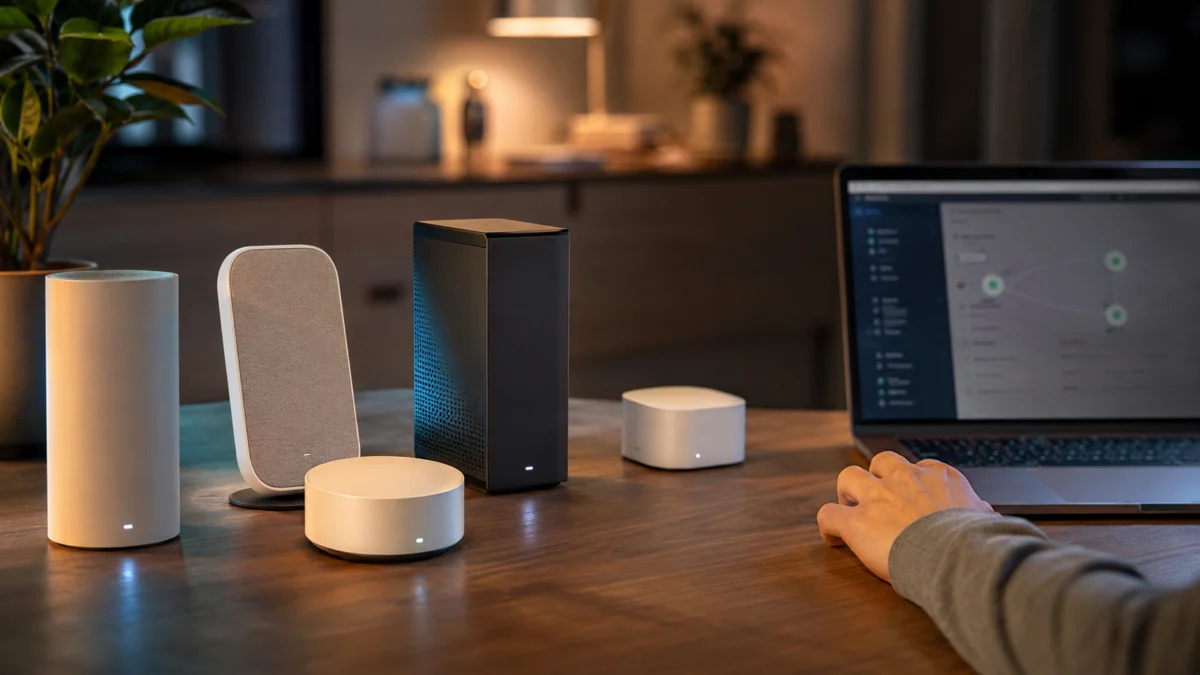
Thread 1.4 standardizes how Border Routers share network credentials with each other, which is meant to stop rival smart home hubs from each building a separate, competing Thread network. But here is the part most coverage skips: as of 2026, this does not happen automatically. Whether your Apple, Google, SmartThings, Eero, or Home Assistant devices actually merge into one Thread network depends on each platform’s implementation. In many setups you still need a manual step — a QR code, a one-time passcode, or an OS-level keychain sync — to pull everything together. This guide explains what Thread 1.4 genuinely fixes, what it does not fix yet, and exactly what to check in each ecosystem before you assume your network is unified.
Jump to a Section
- Quick Answer: What Thread 1.4 Changes
- What Is a Thread Border Router? (And What It Isn’t)
- Thread 1.4 vs Older Thread Networks
- Credential Sharing Explained
- Apple, Google, SmartThings, Eero & Home Assistant: What to Check
- Will Thread 1.4 Merge My Networks Automatically?
- Troubleshooting Checklist
- FAQ
Quick Answer: What Thread 1.4 Changes for Border Routers
Thread 1.4 standardizes credential sharing — a defined method for one Border Router to hand its network credentials to another, so the second router joins an existing network instead of creating a rival one. The outcome is fewer fragmented networks, but only when your platform actually implements the sharing flow.
It helps to separate two things this update covers. The first is credential sharing itself. The second is a set of supporting upgrades — standardized internet connectivity, network diagnostics, and infrastructure features — that improve reliability behind the scenes. The table below splits what 1.4 genuinely improves from what it does not solve on its own in 2026.
| What Thread 1.4 Improves | What It Does NOT Auto-Solve in 2026 |
|---|---|
| A standardized way for Border Routers to share credentials and join one network | Automatic, hands-off merging of every Thread network in your home |
| Standardized internet connectivity for Thread devices (NAT64/DNS64 for IPv4, prefix delegation for IPv6) | Cross-ecosystem sharing where one brand freely joins another brand’s network |
| Network diagnostics that make troubleshooting easier for installers and advanced users | Forcing Apple, Google, or Amazon to drop their app- or account-level gatekeeping |
| Redundancy: multiple 1.4 routers on one shared network back each other up | Updating older routers that may never receive a 1.4 firmware release |
In short, Thread 1.4 hands the industry a shared toolset. It does not force every manufacturer to use that toolset the same way, which is why “just update everything” is not a guaranteed fix.
What Is a Thread Border Router? (And What It Isn’t)
A Thread Border Router (TBR) is a device that bridges the low-power 802.15.4 Thread mesh to your regular IP network — Wi-Fi or Ethernet. Your phone and laptop cannot talk to Thread devices directly because they lack an 802.15.4 radio, so your home needs at least one TBR to reach Thread accessories like sensors and bulbs.
Three roles get mixed up constantly, and the confusion is the root of most “why won’t this work” frustration. The table clarifies each one.
| Component | What It Actually Does | Common Examples |
|---|---|---|
| Thread Border Router (TBR) | Routes traffic between the Thread mesh and your IP network. It does not interpret Matter commands — it just moves packets. | Apple TV 4K, HomePod mini, Google TV Streamer, Nest Hub, SmartThings Hub, Echo, Eero (newer models), HA with a radio dongle |
| Matter Controller / Hub | The application-layer “brain”: handles device setup (commissioning), runs automations, and provides the user interface. | Apple Home, Google Home, SmartThings, Home Assistant, Amazon Alexa |
| Wi-Fi Router | Provides internet and your home Wi-Fi. On its own it is not a TBR unless it includes an 802.15.4 Thread radio. | Most standard routers; some Wi-Fi 7 mesh units (e.g. certain Eero models) embed a TBR |
Many smart speakers and displays bundle both a TBR and a Matter Controller into one box, which is exactly why people treat them as a single thing. They are logically separate functions, and understanding that split makes the rest of this guide far easier to follow.
Thread Group: Thread 1.4 Features White Paper / Thread Group: Thread 1.4 release and certification program / Connectivity Standards Alliance: Matter 1.4 and HRAP
Thread 1.4 vs Older Thread Networks: The Practical Difference
The practical difference is credential sharing. On Thread 1.3 and earlier, a new Border Router with no way to receive existing credentials would spin up its own separate network. Thread 1.4 defines a standard method to pass those credentials along, so a second router can join the network already in your home instead of competing with it.
Beyond credential sharing, the Thread Group specification adds several behind-the-scenes upgrades worth knowing:
- Internet Connectivity: A standardized path for Thread devices to reach the cloud — IPv4 via NAT64/DNS64 and IPv6 via prefix delegation — which improves reliability for cloud-dependent automations and firmware updates.
- Network Diagnostics: Detailed mesh and per-node data that makes troubleshooting easier for advanced users and professional installers.
- Thread over Infrastructure: The ability to extend the mesh across existing Wi-Fi or Ethernet links, acting as a kind of mesh extender into hard-to-reach areas.
- TCAT (Thread Commissioning over Authenticated TLS): A certificate-based method for adding devices securely, aimed at enterprise and large-scale deployments.
For a typical home user, credential sharing is the change you will notice. The others mostly improve stability and scale rather than day-to-day setup.
Credential Sharing Explained: Why It Matters for Matter Homes
Credential sharing lets multiple Border Routers operate on the same Thread network using the same operational dataset. When that happens, the routers act as redundant paths: if one is unplugged or goes offline, your Thread devices automatically route through another. That redundancy is what makes a Matter home feel reliable instead of fragile.
The Thread Group specification describes the sharing flow in broad terms: a device discovers a Border Router over the local IP network using mDNS, derives a short-lived key from a one-time passcode (often shown as a QR code), establishes a secure session, and then transfers the network credentials. The practical payoff is fewer “islands.” Instead of an Apple network and a separate Google network coexisting and ignoring each other, well-configured routers can share one mesh.
Why does fragmentation hurt so much? Picture a temperature sensor in the bedroom that has to reach a controller in the living room. If your home has one unified network, any nearby router relays the signal. If it has two isolated networks, the sensor may be stuck straining toward a distant router on its own network, which can mean higher latency, abnormal battery drain, and dropped messages — the kind of flakiness that breaks routines.
Apple, Google, SmartThings, Eero & Home Assistant: What to Check (2026)
This is where reality diverges from the spec. Thread 1.4 defines how sharing can work, but each ecosystem implements it differently — and some not at all yet. The table below summarizes where the major platforms stand in 2026; details and caveats follow underneath.
| Platform / Device | Acts as TBR | Thread 1.4 | Credential Sharing Behavior | What to Check |
|---|---|---|---|---|
| Apple TV 4K / HomePod & mini | Yes | Yes (recent tvOS/iOS releases) | Relies on the iOS Keychain; no QR-based manual sharing UI | Update tvOS/iOS; sharing into other ecosystems happens through the Home app and the iPhone keychain, not a QR scan |
| Google TV Streamer | Yes | Yes (recent firmware build) | One-sided: can share its credentials out, but cannot join another network from its own UI | Confirm the firmware update applied; expect to invite others to its network, not the reverse |
| Google Nest Hub (2nd Gen) / Max | Yes | Often still 1.3 / pending | Pending on many units | Many older Nest devices remain on 1.3; do not assume parity with the newer Streamer |
| Samsung SmartThings Hub / Station | Yes | Yes | Bidirectional — one of the earliest practical implementations | Can both share out and join other networks; a strong anchor for a unified mesh |
| Amazon Echo (4th Gen) / Echo Hub | Yes | Mostly 1.3 / pending | No standardized sharing in practice | Tends to build its own network; joining an existing one is unreliable today |
| Amazon Eero (Pro 6 / 6+ / newer 7) | Yes | 1.3 (newer Eero 7 generation on 1.4) | Limited | Check your exact model; older Eero units may stay on 1.3 |
| Home Assistant (SkyConnect / ZBT dongles) | Yes (OpenThread Border Router) | Yes (OTBR add-on beta, recent versions) | Via OS sync; the OTBR GUI has no QR input | You must run “Sync Thread Credentials” from the Android/iOS companion app to register the network with the mobile OS |
| IKEA Dirigera Hub | Yes | Yes (recent firmware) | Open, bidirectional (generates a passcode for sharing) | One of the more open implementations; can share to and join other networks |
Apple: Apple’s ecosystem does not use a QR code for sharing. Instead it stores credentials in the iOS Keychain and keeps a relatively closed, account-based approach. To integrate with another platform such as Home Assistant, you typically tap an option like “send credentials” from the companion app on your iPhone to push them out at the OS level.
Google: The Google TV Streamer can display a QR or sharing code so other devices can “join” its network, but its UI does not provide a way to enter another network’s code and join that one. This asymmetric design — share out, but not join in — is the single most important quirk to understand if you mix Google with other brands.
SmartThings & IKEA: SmartThings was among the first to make bidirectional credential sharing practical, and IKEA’s Dirigera takes a similarly open approach. Codes generated by these hubs can often be read by other platforms, but Apple and Google’s first-party apps frequently lack a clear menu to directly consume an outside QR code and migrate their own routers onto that network.
Home Assistant: Home Assistant offers a powerful OpenThread Border Router, but its mobile commissioning depends on the OS-level credential store (iOS Keychain or Google Play Services). To add Matter-over-Thread devices to a Thread network you built in Home Assistant, you generally must run “Sync Thread Credentials” from the companion app so the OTBR’s network is registered with your phone’s OS first.
Apple: Managing Thread network credentials / Apple: Set up your HomePod, HomePod mini, Apple TV, or iPad as a home hub / Google Home Developers: Thread and Google Play services / Google TV Help: Meet Google TV Streamer / SmartThings: two-way Thread network unification / IKEA: DIRIGERA and Matter over Thread / Amazon: Matter support and Thread border router device list / eero: Thread support / Home Assistant: Thread integration / Home Assistant: OpenThread Border Router add-on
Will Thread 1.4 Merge My Existing Thread Networks Automatically?
No. Thread 1.4 provides a standardized method for routers to share credentials, but it does not force them to merge on its own. Because of platform-level implementation choices — like Google’s one-way sharing or Apple’s reliance on the iOS Keychain — simply setting up a 1.4 router in a different ecosystem does not automatically fold every network into one.
Two separate features get confused here, and the distinction matters:
- Matter Multi-Admin lets a single device be controlled from multiple apps (for example, both Apple Home and Google Home). This is about device control, and it uses a Matter pairing code.
- Thread Credential Sharing is about getting routers to share the same radio network. This uses a Thread one-time passcode, which is a different thing entirely.
Pairing a device into a second app via Multi-Admin does not unify your Thread networks. If you mix up the two, the network merge you are hoping for simply will not happen.
Troubleshooting Checklist: When Matter Thread Devices Won’t Join the Right Network
When a Matter-over-Thread device refuses to appear, splits onto its own network, or keeps dropping, the fix is usually methodical rather than mysterious. The fix takes 5 steps. Work through them in order before resetting anything.If you are running into “Thread Border Router not found” or stalled Matter pairing despite having a 1.4-capable router, our step-by-step guide to fixing “Thread Border Router not found” and Matter pairing failures walks through the platform-specific checks for Apple Home, Google Home, Alexa, SmartThings, and IKEA
- Confirm transport: Wi-Fi vs Thread. Check the device’s documentation to see whether it is Matter-over-Wi-Fi or Matter-over-Thread. Mains-powered gear like smart plugs is often Wi-Fi; battery sensors are usually Thread. If it’s Thread, also confirm there is a powered, always-on TBR or Thread router (such as a mains-powered smart plug that acts as a router node) within radio range.
- Verify Bluetooth and handshake. Initial commissioning uses your phone’s Bluetooth Low Energy (BLE) to hand over credentials. Make sure your phone is on the same Wi-Fi network as the TBR and that Bluetooth is enabled, or the handshake can stall.
- Check IPv6 and mDNS. Thread relies on IPv6 inside the network. In your home router’s admin panel, confirm that local IPv6 routing and multicast DNS (mDNS) traffic are allowed to pass. Some router “security” features silently block this.
- Identify how many Thread networks exist. In Apple Home, check Home Settings → “Home Hubs & Bridges” to see which devices are connected. In Home Assistant, open the Thread panel under Settings to see whether multiple network names are listed side by side. If you find more than one, that is your fragmentation.
- Unify, then reset as a last resort. Pick one primary platform as the anchor (for example, Apple Home or SmartThings). Where the platform allows it, feed the shared credentials from your other routers into that one network. If a router built its own stubborn network and won’t merge, a factory reset of that router — then re-adding it through the anchor controller — is the most reliable way to fold it in. Removing it from the app alone may not clear its stored network key.
One caution before you reset anything: a factory reset wipes that router’s network credentials, so plan to re-commission any Thread devices that depended on it. Reset only after confirming the device genuinely sits on a separate network.
What Real Users Are Reporting
Beyond the specifications, recurring themes show up across community forums. We include only patterns confirmed across multiple threads, not one-off posts.
- Google’s “share out, can’t join in” confusion. According to multiple community reports, some Google TV Streamer owners can display a sharing QR code but cannot find any screen to join another network, so adding the Streamer into an existing Apple-based setup leaves the network split in two. Check whether your situation matches before assuming it’s a bug.
- Amazon Echo staying isolated. According to multiple community reports, some users find their Echo devices won’t join an existing Thread network (such as one run by Eero or Home Assistant) and instead form their own, leaving accessories stranded. This does not appear to affect every setup, so confirm your configuration first.
- Home Assistant credential sync failures. According to multiple community reports, some Home Assistant users hit a wall during commissioning because the credential sync with Google Play Services or the iOS Keychain didn’t complete. The manual “Sync Thread Credentials” step in the companion app is easy to miss and is often the missing piece.
Related Reddit discussion: Google TV Streamer Thread 1.4 / Related Reddit discussion: Echo and existing Thread networks / Home Assistant Community: Sync Thread credentials failed / Home Assistant Community: Matter/Thread devices unavailable
How We Researched
This article is based on the Thread Group specification, Connectivity Standards Alliance (Matter) documentation, and the official support materials of the relevant platforms, supplemented by community reports where the same issue was confirmed across multiple threads. We have not conducted hands-on lab testing. Any version status, compatibility claim, or behavior described here is attributed to official sources or clearly identified community reports, and platform support is changing quickly, so verify your specific device’s firmware before making purchase or setup decisions.
FAQ: Thread 1.4 Border Routers and Matter Smart Homes
Does Thread 1.4 replace Matter?
No. Thread is the low-power wireless network layer that carries the data, while Matter is the application layer that defines how devices and apps talk to each other. They work together: Matter devices frequently run “over Thread,” but the two are separate standards with separate version numbers.
Can I use an Apple TV and a Google TV Streamer together?
Technically yes — both can act as Thread Border Routers on the same network. In practice, current UI limitations make automatic merging difficult, since Google’s sharing is one-directional and Apple keeps credentials in its keychain. Expect some manual configuration rather than instant unification.
Do I need to buy new devices for Thread 1.4?
Not necessarily for your end devices like sensors and bulbs. The bigger question is your Border Routers: some older hubs and routers may never receive a Thread 1.4 firmware update, and those are the units that limit credential sharing. Check each router’s firmware status rather than replacing everything.
What’s the difference between Matter Multi-Admin and Thread Credential Sharing?
Matter Multi-Admin shares control of a device across multiple apps using a Matter pairing code. Thread Credential Sharing shares the radio network itself between routers using a Thread passcode. Unifying your network requires the second one; the first only adds a device to another app.
The Bottom Line
Thread 1.4 is best understood as the standard finally catching up to what Matter homes always needed: a defined way for Border Routers to share one network instead of fracturing into rival islands. The catch in 2026 is that the standard arrived before the implementations did. SmartThings and IKEA already share credentials in both directions, Google shares one-way, Apple keeps things inside its keychain, and several Amazon and older Nest devices are still on 1.3.
So the realistic move is not to wait for magic. Pick one capable platform as your network anchor, update the routers that can update, and use each ecosystem’s specific sharing step to pull the others in. If you’re still seeing devices that won’t join the right network, our companion guide on fixing a Matter Thread Border Router that isn’t found walks through the recovery steps in detail.