
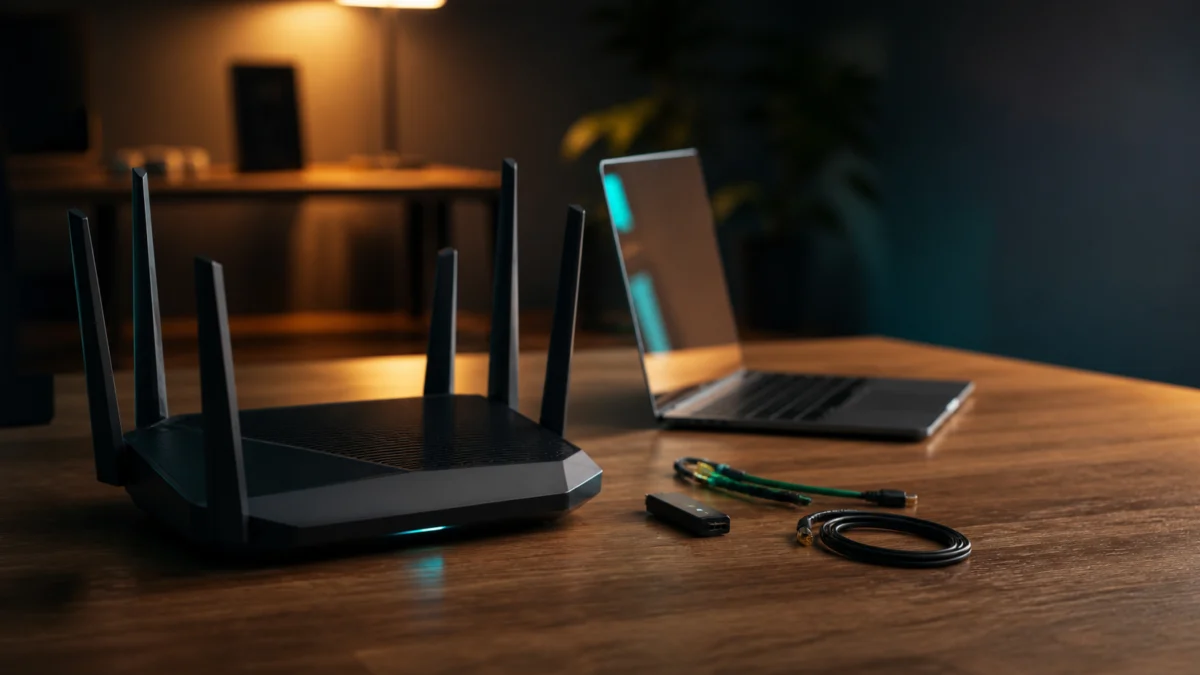
If your Wi-Fi 7 connection keeps dropping, freezing after sleep, or killing your SSH and Remote Desktop sessions, you are not dealing with a hardware failure. MLO (Multi-Link Operation) on Windows 11 has known driver and OS-level bugs — and three targeted fixes resolve the majority of cases.
This guide covers the full three-layer fix: Windows OS and Intel BE200 adapter settings, ASUS router configuration, and TP-Link router flow control. It also includes a fallback for mobile and IoT devices losing connection due to MLO frame misalignment.
Wi-Fi 7 MLO Disconnects on Windows 11: What’s Actually Happening
Wi-Fi 7’s core feature, MLO, transmits data simultaneously across the 2.4GHz, 5GHz, and 6GHz bands. According to Intel performance data, MLO reduces latency by 35–48% compared to Wi-Fi 6, cuts MAC-layer jitter by up to 40%, and doubles throughput in heavy interference conditions. Under ideal conditions, MediaTek-based routers have demonstrated peak speeds up to 6.5 Gbps using simultaneous tri-band MLO.
The problem is that the software stack — Windows 11, Intel’s BE200 driver, and router firmware — has not caught up to the hardware’s capability. Three specific failure modes account for most reported disconnects.
Failure Mode 1: Sleep-Wake Freeze (Modern Standby / S0ix)
After the PC wakes from Modern Standby or S3 sleep, the BE200 adapter goes completely silent. SSH and RDP sessions drop immediately. This is consistently reported on Dell XPS 13 and other thin-and-light Windows 11 laptops. The root cause is an ASPM (Active State Power Management) conflict: the adapter fails to respond to the AP’s sync frames within the expected timeout window after waking.
Failure Mode 2: Ghost Adapter / MLO Association Failure
On some Windows 11 24H2 systems, the BE200 appears in Device Manager as multiple virtual adapters — “Wi-Fi,” “Wi-Fi 2,” and so on. When this happens, the adapter cannot associate with MLO-only SSIDs such as those broadcast by the TP-Link Deco BE85. The connection attempt is rejected at the association stage.
Failure Mode 3: Router Thermal Shutdown
On TP-Link Archer BE800 and GE800 units, the antenna area has been reported reaching 75–90°C under sustained MLO load. At that temperature, the wireless module triggers a forced shutdown, causing all SSIDs to disappear for several minutes before recovering. This is a firmware-level thermal management issue, not a defective unit.
Quick Fix Checklist
- Confirm Windows 11 24H2 or later is installed. Versions below 24H2 cannot support MLO at the OS architecture level and fall back silently to Wi-Fi 6E.
- Apply the Intel BE200 registry fix to force-enable 6GHz band support (details in Fix 1 below).
- Disable power management on the BE200 adapter to prevent sleep-wake timeouts.
- Disable flow control on your TP-Link router to stop packet aggregation buffer errors.
- Verify your ASUS router’s MLO setup order — enabling MLO through Guest Network Pro causes a VLAN conflict that blocks IP address assignment.
Fix 1 — Intel BE200: Registry Edit and Power Management
Step 1: Verify Windows 11 24H2
- Press Windows + R, type
winver, and press Enter. - Confirm the version reads 24H2 or higher.
- If it reads 23H2 or earlier, go to Settings → Windows Update and install all available updates before proceeding. MLO will not function on earlier versions regardless of any other fix applied.
Step 2: Force-Enable 6GHz Band via Registry
- Press Windows + R, type
regedit, and press Enter. Confirm the UAC prompt. - Navigate to:
HKEY_LOCAL_MACHINESYSTEMCurrentControlSetControlClass{4d36e972-e325-11ce-bfc1-08002be10318} - Open each numbered subkey (0000, 0001, 0002, etc.) and check the DriverDesc value. Stop at the subkey where DriverDesc reads Intel Wi-Fi 7 BE200.
- Inside that subkey, right-click the empty area → New → DWORD (32-bit) Value.
- Name the new value:
Is6GHzBandSupported - Double-click it and set the value data to
1. - Click OK, then restart the computer.
After restarting, open Settings → Network & Internet → Wi-Fi → Show available networks and confirm that 6GHz networks are now visible.
Step 3: Disable Power Management on the BE200 Adapter
- Right-click the Start button → Device Manager.
- Expand Network adapters and double-click Intel Wi-Fi 7 BE200.
- Go to the Power Management tab.
- Uncheck “Allow the computer to turn off this device to save power.”
- Click OK.
This prevents the ASPM conflict that causes the adapter to miss AP sync frames after waking from Modern Standby.
Step 4: Update the BE200 Driver
In Device Manager, right-click the BE200 adapter → Update driver → Search automatically for drivers. Alternatively, download the latest driver package directly from Intel’s support site.
Fix 2 — ASUS Router: Correct MLO Setup Order
ASUS routers including the GT-BE98 require a specific configuration sequence to enable MLO correctly. Enabling MLO through the Guest Network Pro option creates a VLAN mapping conflict that prevents connected devices from obtaining an IP address. Follow this order instead.
- Factory reset the router. Hold the reset button for 10 seconds until the power LED blinks.
- Complete the initial setup wizard and configure your primary Wi-Fi 7 network first. Do not enable MLO during this stage.
- After the primary network is stable, log in to the router’s web admin panel.
- Go to Wireless → MLO tab.
- Enable MLO from this tab only.
ASUS ROG Rapture GT-BE98 product page
AiMesh Users: RT-BE92U Satellite Node
Adding an RT-BE92U as an AiMesh satellite node has been reported to disable MLO on the parent GT-BE98. To fix this:
- In the RT-BE92U’s admin panel, set the node to AP mode.
- Enable WiFi Agile Multiband in the wireless settings.
Fix 3 — TP-Link Router: Disable Flow Control and Stabilize WAN Speed
Step 1: Disable Flow Control
MLO aggregates packets across multiple bands simultaneously. TP-Link’s default flow control settings introduce buffer errors when processing this aggregated traffic. Disabling flow control eliminates the most common source of MLO-induced packet loss on Archer BE800 and GE800 units.
- Log in to the TP-Link router’s web admin panel.
- Go to Advanced Settings.
- Locate the Flow Control section.
- Turn off RX Enable.
- Turn off TX Enable.
- Save the settings and allow the router to apply the change.
TP-Link Archer BE800 product page
TP-Link Archer GE800 product page
Step 2: Manually Set WAN Link Speed
If the 10G WAN port negotiation is unstable — causing periodic full disconnections rather than just drops — auto-negotiation may be the source. Set the WAN link speed manually:
- In the TP-Link admin panel, locate WAN port settings or Advanced → Network.
- Change the link speed from Auto to 10000Mbps Full Duplex.
- Save and reboot the router.
Fix 4 — Mobile and IoT Devices: Lock 2.4GHz to 20MHz
Devices that show an “Unassociated” MLO status — including the Samsung Galaxy S24 Ultra in some configurations — and IoT devices that repeatedly lose their IP address are often experiencing MLO frame phase misalignment on the 2.4GHz band. Locking the 2.4GHz channel width to 20MHz strictly reduces this misalignment.
- Log in to your router’s admin panel.
- Go to the Wireless settings for the 2.4GHz band.
- Set Channel Width to 20MHz (do not use 20/40MHz auto).
- Save the settings.
Note that this setting applies to all 2.4GHz clients on the network, not just the problematic device. The throughput impact on modern devices is minimal, as 2.4GHz carries background and control traffic rather than bulk data in an MLO session.
If Nothing Works: When to Disable MLO
If the fixes above do not stabilize your connection, disable MLO entirely. Either separate the 2.4GHz, 5GHz, and 6GHz bands into individual SSIDs and connect to the 6GHz band directly, or turn MLO off in the router’s wireless settings.
This is not a permanent step backward. Wi-Fi 7 hardware on a single 6GHz band still outperforms Wi-Fi 6E for most workloads. The right approach is to build a stable foundation first, then re-enable MLO as Windows updates and router firmware mature. Both Intel and ASUS have active support threads tracking these issues, and driver-level fixes have been shipping incrementally.
Intel Community: Intel BE 200 Windows 11 Constant Drops
Intel Community: Windows 11 with Intel Wi-Fi 7 BE200 can’t detect 6GHz network
ASUS ROG Forum: GT-BE98 – WIFI 7 Issue
How We Researched
This article is based on three primary sources: active threads in the Intel Community support forums tracking BE200 driver behavior on Windows 11, the ASUS ROG Forum thread documenting GT-BE98 MLO configuration issues, and Intel’s published MLO performance benchmarks. Failure modes and fix procedures were cross-referenced across multiple user-reported cases in those forums before inclusion. No lab testing was conducted by Fixory.
Final Notes: Build Stable, Then Re-Enable
Wi-Fi 7 MLO is a real performance advance — the latency and throughput gains are documented and significant. The current disconnect and freeze issues are software problems, not reasons to avoid the hardware. Apply the three-layer fix in order: Windows 24H2 and BE200 registry first, router configuration second, and band-width locking for legacy clients third. Monitor stability for 48–72 hours after each change before moving to the next. That sequence isolates the source of your specific disconnect pattern and avoids chasing multiple variables at once.




Comments